

Maria works at a poultry plant in Arkansas through the EB-3 visa program. Her mother lives in Guatemala, and Maria wants to visit her. Whether she can safely go, and what she needs to bring, depends on where her case is.
The green card travel rules change at each stage of the EB-3 visa process. A trip that is safe for a green card holder can end a pending application, and a trip that is fine at 3 months can cause problems at 8 months. This guide explains each stage, including the travel restrictions green card holders face in 2026.
| Where you are in the process | Can you travel? | What you need |
|---|---|---|
| EB-3 case pending, adjusting status inside the U.S. | Only with permission | Advance parole (Form I-131) before you leave |
| Immigrant visa issued, green card not yet in hand | Yes | Passport with your immigrant visa and CBP admission stamp |
| Green card holder | Yes | Green card + passport. A re-entry permit for trips of 1 year or more |
Traveling While Your EB-3 Visa Case Is Still Pending
The rules for a pending case depend on which path you are taking to your green card. There are two:
- Adjustment of status: you are already in the U.S. and you file Form I-485 to get your green card without leaving.
- Consular processing: you complete your case at a U.S. embassy or consulate abroad.
If you’re not sure which applies to you, read our guide to EB-3 visa adjustment of status vs. consular processing.
Adjustment of Status: Get Advance Parole Before You Leave
If you have a pending Form I-485 and you leave the U.S. without advance parole, USCIS generally treats your green card application as abandoned. You lose the application and the fee, and you may not be able to return.
There is a narrow exception. People who are maintaining H-1B or L-1 status (and their H-4 or L-2 family members), or K-3/K-4 or V status, can usually travel and return on a valid visa in that status without abandoning the I-485.
F-1 students and H-2B workers are not on that list. This is where many EB-3 visa applicants get caught. If you are changing from student status (F-1 to EB-3) or from seasonal work (H-2B to EB-3), plan to stay in the U.S. until you have advance parole in hand.
Example: Kevin, on an F-1 visa, is adjusting status through an EB-3 visa job. He flies to Vietnam for his cousin’s wedding without advance parole, and USCIS treats his I-485 as abandoned. He may have to finish through consular processing, and a new student or visitor visa will be hard to get now that he has shown he intends to immigrate.
How to Get Advance Parole
You apply for advance parole with Form I-131, Application for Travel Document. Most EB-3 visa applicants file it together with the I-485, but you can also file it while the I-485 is pending.
- Fee: Since April 1, 2024, the I-131 has its own fee even when you file it with your I-485. The fee is $630 (8 CFR 106.2). Fees change, so check the USCIS fee schedule on the day you file.
- Combo card: If you also applied for a work permit, USCIS often issues one card that works as both your work permit (EAD) and advance parole document.
- Wait for the document. You need the approved document in your hands before you leave. A receipt notice is not enough.
- Check the dates. The document must still be valid on the day you come back.
For more background, see our glossary entry on advance parole for EB-3 visa applicants.
Advance Parole Is Not a Guarantee
U.S. Customs and Border Protection (CBP) still decides whether to let you back in. Expect secondary inspection and questions. Bring your I-797C receipt notice for the I-485 and your advance parole document (Form I-512L or the combo card) together.
These also show that you are exempt from the roughly $1,000 immigration parole fee created by H.R. 1 in 2025, which doesn’t apply to adjustment applicants returning from temporary travel.
If you have ever been in the U.S. without status, been arrested (even if the case was dismissed), or had a removal order, talk to an immigration attorney before you travel. Advance parole does not solve those problems.
If You Are Using Consular Processing
If you are abroad waiting for your embassy interview, you enter once your immigrant visa is issued. If you are in the U.S. on another visa, your trips follow that visa’s rules. Check with your employer’s attorney first, because a pending EB-3 visa case can make it harder to renew a nonimmigrant visa.
Your First Entry on an EB-3 Immigrant Visa
If you go through consular processing, you will receive an immigrant visa in your passport after your interview. This is the visa you use to enter the U.S. as a new permanent resident.
Before You Travel
- Enter before the visa expires. An immigrant visa is usually valid for about 6 months from the date it is issued, sometimes less if your medical exam expires sooner. You must arrive by the date printed on the visa (U.S. Department of State).
- Pay the USCIS Immigrant Fee. Pay it online after you get your visa and before you travel. USCIS will not produce your green card until it is paid. The fee is $235.
- Family members enter with you or after you. Your spouse and children cannot enter the U.S. before you do on their EB-3 immigrant visas.
How the Passport Stamp Works Until Your Card Arrives
When you arrive, a CBP officer admits you and stamps your passport. That admission stamp shows your permanent resident status and is valid for 1 year from the date you entered (U.S. Embassy in Brazil, Department of State).
Until your physical card arrives, you can use your passport with the immigrant visa and admission stamp to:
- Start work and complete Form I-9 with your employer
- Apply for a Social Security number and a driver’s license (see our driver’s license guide for EB-3 green card holders)
- Travel abroad and come back, as long as the stamp is still valid
USCIS mails the green card to the U.S. address you gave the State Department or the CBP officer. If you move, update your address with USCIS right away. If your card has not arrived after about 90 days, contact USCIS, and do it well before your 1-year stamp expires.
Example: Ana enters the U.S. in March to start her EB-3 visa job at a hotel. In July, her card still hasn’t arrived and she has a family trip to Honduras planned. She can travel on her passport with the admission stamp, which is valid until March of next year. If she were going to be abroad past that date, someone in the U.S. would need to mail her the card first.
Renewing Your Green Card
EB-3 green cards are 10-year cards. When yours is close to expiring, you renew it with Form I-90.
- When to renew: within 6 months before the expiration date, or any time after it has expired.
- Your status doesn’t expire with the card. You are still a permanent resident. Only your proof of status has expired.
- The receipt notice extends your card. When you file Form I-90, your receipt notice extends your card’s validity by 36 months. In most cases, you can travel using your expired card together with that receipt notice.
For the full steps, fees and the details of the 36-month extension, see our post on green card renewal and the 36-month extension.
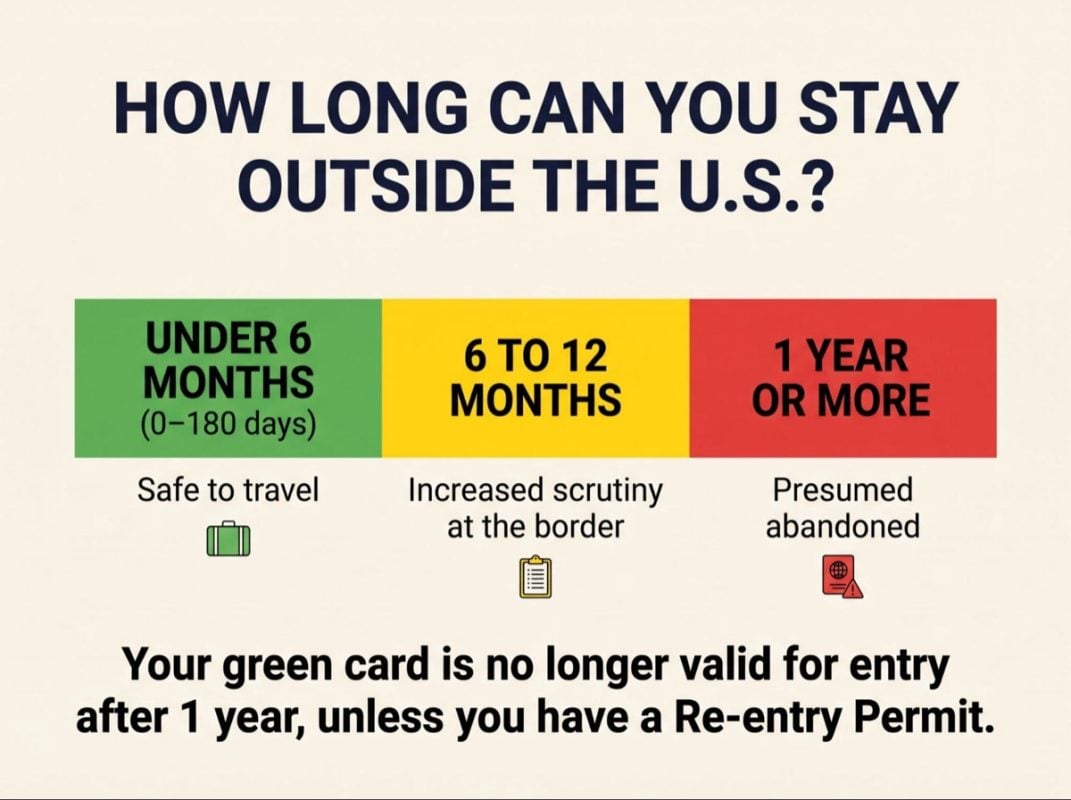
How Long Can You Stay Outside the U.S. With a Green Card?
No number of days is automatically safe. A green card means the U.S. is where you live, and the longer you stay away, the more the government will question that (USCIS: International Travel as a Permanent Resident).
| Length of trip | What happens when you come back | What you need |
|---|---|---|
| Under 6 months | Usually a routine return | Green card + passport |
| More than 6 months (180 days), less than 1 year | CBP can treat you as seeking admission, meaning you can be questioned as if you were entering for the first time | Green card + passport + proof of your ties to the U.S. |
| 1 year or more | Your green card alone is no longer a valid entry document, and you are presumed to have abandoned your status | A re-entry permit obtained before you left, or an SB-1 returning resident visa |
The 1-year limit comes from 8 CFR 211.1. Past that point without a re-entry permit, your options are an SB-1 visa (explained below) or a new immigration case.
It’s About Where You Live, Not Only the Number of Days
Abandonment of a green card is about intent and ties, not just a day count. Even short trips can cause problems if you spend most of the year abroad and only come back for brief visits. CBP and immigration judges look at whether you:
- Kept your U.S. job, or have approved leave from your employer
- Kept your home or lease in the U.S.
- Have close family living in the U.S.
- Kept U.S. bank accounts, a driver’s license and other ties
- Filed U.S. taxes as a resident. Filing as a “nonresident” is a red flag that you have moved abroad.
Example: Joseph, a meatpacking worker in Nebraska, spends 8 months in the Philippines after his father’s surgery. Before leaving, he gets written approval for unpaid leave, keeps paying rent and files his U.S. taxes as a resident. He brings copies of all three when he returns. He may get questions, but he has strong evidence that he still lives in the U.S.
Don’t Sign Form I-407 Unless You Mean It
If a CBP officer believes you have abandoned your residence, they may ask you to sign Form I-407, which gives up your green card. Signing it is voluntary. If you believe you still live in the U.S., you can decline and ask to have your case heard by an immigration judge. Contact an immigration attorney if this happens.
2026 Update: Stricter Border Checks for Some Green Card Holders
In June 2026, the Supreme Court decided Blanche v. Lau. The case involved a green card holder who had committed a crime before returning from a trip abroad. The Court ruled 6-3 that a CBP officer does not need “clear and convincing evidence” that a returning green card holder committed a crime before treating that person as seeking admission (Supreme Court opinion).
For EB-3 visa workers and families with clean records, a normal trip works the same as before. But if you have any criminal history, including an arrest or a dismissed or reduced charge, talk to an immigration attorney before you leave the U.S.
Re-Entry Permits: For Trips Longer Than a Year
A re-entry permit is a travel document for green card holders who need to be outside the U.S. for a long time. It shows that you did not intend to give up your permanent residence, and it lets you return after an absence of 1 year or more without needing a returning resident visa.
Who Needs One and How Long It Lasts
You need one if you plan to be abroad for 1 year or more, for example to care for a sick parent. It can also help for a long trip under a year, as extra proof that you planned to come back.
A re-entry permit is usually valid for 2 years from the date it is issued, and it can’t be renewed (8 CFR 223.3). If you have spent more than 4 of the last 5 years outside the U.S. since becoming a permanent resident, USCIS will generally limit the permit to 1 year.
How to Apply Before You Leave
- File Form I-131 while you are in the U.S. You must be physically in the U.S. when you file. You cannot apply from abroad.
- Pay the fee. The re-entry permit fee is $630, the same as for advance parole. Check the USCIS fee schedule before filing.
- Attend your biometrics appointment in the U.S. USCIS takes your fingerprints and photo. Plan to stay in the U.S. until this appointment is done.
- Choose where to get the permit. You can have it mailed to your U.S. address, or ask USCIS to send it to a U.S. embassy or consulate abroad so you can pick it up there.
- Leave once biometrics are done. Leaving after you file does not cancel the application.
File as early as you can. Processing can take months (check current USCIS processing times), so a few months before your trip is better than a few weeks. Each family member who needs a re-entry permit must file their own I-131 and pay their own fee.
A re-entry permit does not guarantee re-entry, and it does not replace living in the U.S. Years abroad on one permit after another can still lead to an abandonment finding. It also does not protect your time toward citizenship (see below).
Stayed Abroad Too Long? The SB-1 Returning Resident Visa
If you stayed outside the U.S. for more than 1 year (or past the expiration of your re-entry permit) for reasons outside your control, you can apply for an SB-1 returning resident visa at a U.S. embassy or consulate (U.S. Department of State).
You must show that:
- You were a permanent resident when you left
- You left for a temporary visit and always planned to return
- You stayed longer because of something you couldn’t control, such as a serious illness or a disaster
You start with Form DS-117. If approved, you also need to complete Form DS-260 and a medical exam. SB-1 visas are hard to get, so the safest plan for a long trip is a re-entry permit before you leave.
Spouses and Children Follow the Same Rules
If your spouse and children got their green cards through your EB-3 visa case as dependents, they are permanent residents in their own right. The same travel rules apply to each of them individually.
- Each family member’s trips are counted separately. Your trips don’t affect their status, and theirs don’t affect yours.
- A family member who will be abroad for 1 year or more needs their own re-entry permit, filed while they are in the U.S.
- The 6-month and 1-year limits apply to children too, including teenagers.
Example: Maria’s 15-year-old son wants to spend a school year with his grandparents in Guatemala. A school year is about 10 months, so he will be gone more than 6 months but less than a year. His green card will still work for re-entry, but CBP may ask questions. If there is any chance the stay could stretch past 12 months, Maria should file a re-entry permit for him before he leaves and keep proof that his home, school enrollment and family are in the U.S.
How Long Trips Affect Your Path to Citizenship
Most EB-3 green card holders can apply for U.S. citizenship after 5 years. Long trips can delay that date.
- A trip of more than 6 months creates a presumption that you broke your continuous residence. You can rebut it with evidence of your U.S. ties.
- A trip of 1 year or more breaks continuous residence.
- Every day you spend abroad counts against the physical presence requirement: at least 913 days in the U.S. during the 5 years.
- A re-entry permit protects your green card, but not your citizenship timeline. A trip of a year or more still breaks continuous residence.
For worked examples and the full rules, see our guide on how to apply for US citizenship after an EB-3 green card.
Before You Travel: A Checklist
Use this before any trip outside the U.S.:
- Valid passport from your home country
- Your proof of status, one of the following:
- Green card
- Passport with your immigrant visa and admission stamp (valid 1 year from entry)
- Expired green card plus your Form I-90 receipt notice (36-month extension)
- Advance parole document + I-485 receipt notice if your case is still pending
- Re-entry permit if you will be gone 1 year or more
- Proof of U.S. ties for trips longer than 6 months (employer leave letter, lease, tax return, bank statements)
- Your home country’s entry rules. Some countries require a visa or a valid passport from their own citizens.
- A travel log. Write down every departure and return date. You will need them for your citizenship application. You can check your records in the CBP I-94 travel history.
- An attorney consultation first if you have any arrest or criminal history
If you lose your green card while abroad, you may need to file Form I-131A at a U.S. embassy or consulate to get a travel document (carrier documentation) before an airline will let you board.
Frequently Asked Questions
What is the 6-month rule for green card holders?
After more than 6 months (180 days) abroad, CBP can treat you as seeking admission and question whether you still live in the U.S. Your green card still works for trips under a year, but bring proof of your U.S. job, home and tax filings.
Can I travel while my EB-3 green card is pending?
If you are adjusting status inside the U.S., you need advance parole (Form I-131) before you leave. Otherwise your I-485 is generally treated as abandoned. People maintaining H-1B or L-1 status are an exception, but F-1 students and H-2B workers are not.
Can I travel before my green card arrives in the mail?
Yes. The admission stamp in your passport from your first entry on an immigrant visa is valid for 1 year as proof of permanent residence. You can travel and return with your passport while the stamp is valid.
Can I travel with an expired green card?
In most cases, yes, if you have filed Form I-90. The receipt notice extends your card’s validity by 36 months, and you can travel with the expired card and the receipt together.
How long can a green card holder stay outside the U.S.?
Trips under 6 months are usually routine, and trips over 6 months can lead to questions at the border. For trips of 1 year or more you need a re-entry permit, or you are presumed to have abandoned your green card.
Do I need a re-entry permit for a trip under a year?
No, your green card is still a valid entry document for trips under a year. A re-entry permit can still help show you planned to return if the trip is long or your U.S. ties are weak.
Can I apply for a re-entry permit from outside the U.S.?
No. You must be in the U.S. when you file Form I-131 and when you attend biometrics. You can have the permit sent to a U.S. embassy or consulate abroad.
What happens if I lose my green card abroad?
You may need to file Form I-131A at a U.S. embassy or consulate to get a travel document so an airline will let you board. Once you’re back, file Form I-90 to replace the card.
Are there new travel restrictions for green card holders in 2026?
The rules on how long you can stay abroad have not changed. The Supreme Court’s June 2026 Blanche v. Lau decision made it easier for CBP to question returning green card holders who have committed a crime, so anyone with a criminal history should talk to an attorney before traveling.
Sources
- U.S. Citizenship and Immigration Services (USCIS): International Travel as a Permanent Resident
- USCIS: Travel Documents
- USCIS: G-1055, Fee Schedule
- Electronic Code of Federal Regulations: 8 CFR 106.2, USCIS fees
- U.S. Embassy in Brazil: Immigrant Visas: Know Before You Go
- U.S. Customs and Border Protection (CBP): Documents Needed for Lawful Permanent Residents
- CBP: I-94 Travel History
- Electronic Code of Federal Regulations: 8 CFR 211.1 and 8 CFR Part 223
- Supreme Court of the United States: Blanche v. Lau, No. 25-429 (June 23, 2026)