
The Dignity Act is moving again. On November 11, 2026, Congresswoman Veronica Escobar (D-TX), one of the bill’s two lead authors, said she is “deeply committed” to reintroducing the Dignity Act in 2027 and reshaping it to win more support from both parties.
For EB-3 visa workers and the U.S. employers who sponsor them, this is important news. The Dignity Act includes some of the biggest proposed changes to employment-based green cards in decades, including a change that could free up thousands of EB-3 visa numbers every year.
In this Dignity Act update, we cover what Escobar said, what the bill would change for EB-3, how it would help employers, workers, and the U.S. economy, and how you can help it become law. If you’re ready to act now, visit our Support the Dignity Act page.
Dignity Act Update: What Congresswoman Escobar Said
Rep. Escobar spoke at a press event in Washington, D.C., with fellow members of Congress, the American Business Immigration Coalition Action (ABIC Action), and the South Texas Builders Association. You can read the full transcript of her remarks on her website.
Here are the key points from her update:
- She co-authored the bill with Rep. María Elvira Salazar (R-FL). The Dignity Act is led by one Democrat and one Republican, which is rare for an immigration bill.
- She plans to reintroduce it in 2027. Escobar said she is “deeply committed to ensuring that the Dignity Act is reintroduced in 2027.”
- The bill will be reshaped. She said the bill will be reshaped “in the coming weeks” to attract both Republican and Democratic support.
- It has bipartisan backing. Escobar described the Dignity Act as the only bipartisan, comprehensive immigration reform bill in the House in over a decade, with about 20 Republican and 20 Democratic supporters. She said she wants to grow that number.
- The Senate is paying attention. She said a bipartisan pair of senators is interested in the bill. She did not name them.
Why the Dignity Act Has to Be Reintroduced
The current version of the Dignity Act (H.R. 4393) was introduced in the House on July 15, 2025. It was sent to the House Judiciary Committee and several other committees, and it has not received a vote.
Every two years, a new Congress begins. Any bill that hasn’t passed by then expires and must be filed again. The current Congress ends in early January 2027, so the Dignity Act needs to be reintroduced in the new Congress to stay alive. When that happens, it will get a new bill number.
Reintroduction is also a chance to change the bill. That is why Escobar’s comments about reshaping it matter: the 2027 version may look different from the current one.
Who Supports the Dignity Act
Support for the Dignity Act has grown steadily. In January 2026, Rep. Salazar’s office reported 35 members of Congress supporting the bill and endorsements from about 60 national organizations.
These supporters include employers, farm groups, faith leaders, veterans’ groups, construction groups, and small businesses. Named supporters include the U.S. Chamber of Commerce, the American Bakers Association, the American Legion, and the National Association of Evangelicals.
Important: The Dignity Act is not law. It has not passed the House or the Senate, and nothing in it applies to EB-3 visa cases today. Everything below describes what the bill would do if it passes.
What Is the Dignity Act? A Quick Overview
The Dignity Act is a large, comprehensive immigration bill. It tries to combine ideas that both parties support into one package. Its main parts are:
- Border security. Funding for ports of entry ($2 billion a year for five years), more border surveillance, higher pay for Border Patrol agents, and tougher penalties for illegal reentry.
- Mandatory E-Verify. All U.S. employers would have to confirm new hires’ work authorization electronically, phased in over about two years.
- The Dignity Program. Undocumented immigrants who have lived in the U.S. since December 31, 2020, could apply for legal status. They would pass a background check, pay $7,000 in restitution over seven years, work or study, and check in with the Department of Homeland Security. The program does not include federal benefits and is not a path to citizenship.
- An American worker fund. Restitution payments would fund apprenticeships and job training for U.S. workers.
- Legal immigration changes. Changes to how green cards are counted and given out, plus more funding for the agencies that process cases.
For EB-3 visa workers and employers, the legal immigration section is the part that matters most. It focuses on the same problem that makes the EB-3 process so slow: the backlog.
Why EB-3 Green Card Waits Are So Long Today
To understand how the Dignity Act would help, it helps to know why EB-3 visa cases take so long now.
The EB-3 visa process has several steps: PERM labor certification, the Form I-140 petition, and the final step at a U.S. embassy or through adjustment of status. Each step takes months. But for most EB-3 visa workers, the longest wait is for a visa number to become available. Our guide to the EB-3 visa process explains each step.
The Yearly Visa Limit
Congress limits how many employment-based green cards are given out each year. The EB-3 visa receives about 28.6% of the yearly employment-based total, around 40,000 visas in a normal year.
Within the EB-3 process, the Other Workers category, which covers jobs that need less than two years of training or experience, is limited to no more than 10,000 visas a year.
There is also a per-country limit. No single country can receive more than 7% of employment-based green cards in a year. Countries with very high demand, like India and China, end up with much longer waits.
How Family Members Use Up Visa Numbers
Here is a detail many people don’t know: spouses and children use visa numbers too.
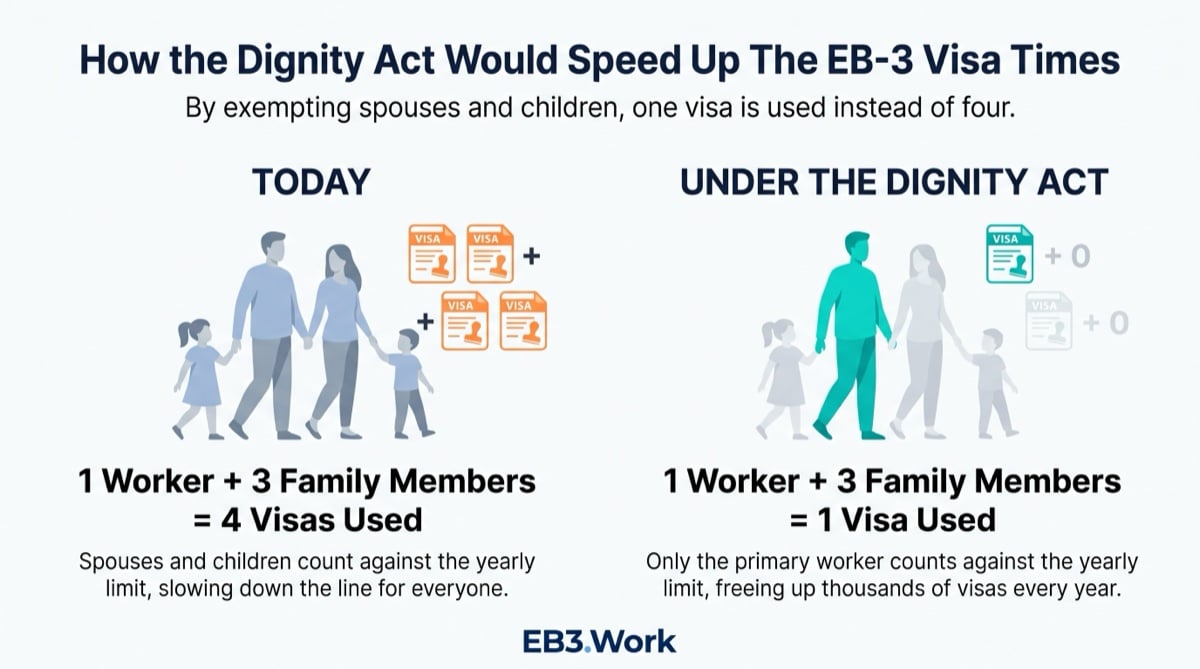
When an EB-3 visa worker immigrates, their spouse and each unmarried child under 21 also receive green cards. Each one counts against the same yearly limit.
Example: Maria is an EB-3 visa worker. She immigrates with her husband and two children. Her family uses 4 visa numbers, not 1. That leaves 3 fewer visas for other workers waiting in line.
Since many EB-3 visa workers immigrate with their families, a large share of the yearly visas goes to family members rather than workers. This is one of the main reasons the line moves so slowly.
Where the EB-3 Visa Line Stands in November 2026
You can see the backlog in the monthly Visa Bulletin. To move to the final step, your priority date (the date your employer filed your PERM application) must be earlier than the date listed for your category and country.
Here are the EB-3 Final Action Dates in the November 2026 Visa Bulletin:
| EB-3 category | Most countries and Mexico | Philippines | China | India |
|---|---|---|---|---|
| Skilled Workers and Professionals | June 15, 2024 | August 15, 2023 | January 22, 2022 | January 22, 2014 |
| Other Workers | June 1, 2022 | January 1, 2022 | October 1, 2019 | January 22, 2014 |
In plain terms, an Other Workers applicant from most countries who filed in mid-2022 is only now reaching the final step. For India, the line is more than 12 years long. That’s why the full EB-3 process often takes four years or more. See our guide to EB-3 visa processing times for a full breakdown.
How the Dignity Act Would Change the EB-3 Visa
The changes below come from the current bill and Rep. Salazar’s section-by-section summary. Because the bill is being reshaped, the 2027 version may be different.
Only the Worker Would Count Against the Visa Limit
This is the most important change for the EB-3 visa.
Under the Dignity Act, only the principal worker would count against the yearly green card limit. Spouses and children would still receive green cards with the worker, but they would no longer use up visa numbers.
Let’s go back to Maria. Today, her family of four uses 4 visa numbers. Under the Dignity Act, her family would use 1. The other 3 visas would go to other workers in line.
Across the whole EB-3 visa category, this could make a big difference. Every visa now used by a spouse or child would be available to another worker. The line would move faster, and more workers could finish their cases each year.
Higher Per-Country Limits
The Dignity Act would raise the per-country limit from 7% to 15% for both employment-based and family-based green cards.
This change would help most in countries with the longest backlogs, especially India and China. It could also help the Philippines, which sometimes has its own EB-3 visa cutoff dates. For workers from most other countries, the family change above would likely have a bigger effect.
A Goal to Clear the Longest Backlogs by 2035
The bill sets a goal of clearing employment-based and family-based backlogs of 10 years or more by 2035.
It would also create an option for people who have waited the longest. Applicants with an approved petition who have waited at least 10 years could pay a $20,000 fee to receive their green card. This mostly affects workers from India and other countries with very long waits.
Protection for Children Who Turn 21
Children who turn 21 while their parent’s case is pending can “age out.” They lose their status as a dependent and can no longer immigrate with the family.
The Dignity Act includes protections so that some children legally in the U.S. would not age out because of processing delays. For families facing long waits, this could mean the difference between immigrating together and being separated.
More Funding for the Agencies That Process EB-3 Visa Cases
The bill would add new funding for every agency involved in an EB-3 visa case:
- $225 million for the Department of Labor’s Office of Foreign Labor Certification, which handles PERM
- $2.56 billion for USCIS, which handles I-140 petitions and adjustment of status
- $852 million for the State Department’s Bureau of Consular Affairs, which handles visa interviews
It would also create an Immigration Agency Coordinator to help the three agencies work together better.
Note: The bill does not redesign the PERM process itself. Any improvement in PERM times would come from more staff and resources, not new rules.
How the Dignity Act Would Benefit EB-3 Visa Employers
Many U.S. employers turn to the EB-3 visa because they can’t find enough local workers. This is common in fast food, manufacturing and assembly, commercial cleaning, construction, hospitality, and senior care. For these employers, the biggest problem with the EB-3 visa is time. The Dignity Act would help in several ways.
Workers Would Arrive Sooner
Today, an employer that starts an EB-3 visa case may wait four years or more before the worker can start. Business needs can change a lot in that time.
If family members no longer used visa numbers, the EB-3 visa line would move faster. Sponsored workers could arrive sooner, helping employers fill open positions while they still need them.
More Predictable Hiring Plans
Long, uncertain waits make it hard to plan. Employers often don’t know whether a worker will arrive in three years or five.
Shorter backlogs and better agency coordination would make EB-3 visa timelines more predictable. Employers could plan hiring around realistic dates and sponsor workers with more confidence.
Better Retention
When a case takes many years, workers sometimes give up. They take other jobs, change plans, or their family situation changes.
Faster processing means fewer workers drop out of the process. Workers who arrive with their families, without losing a child to aging out, are also more likely to stay with their sponsoring employer for the long term.
Faster Processing at Every Step
New funding for the Department of Labor, USCIS, and the State Department could reduce delays at each step of the case, from PERM to the final visa interview. Even small time savings at each step add up.
What Employers Should Prepare For: Mandatory E-Verify
The Dignity Act would also create new duties for employers. The biggest is mandatory E-Verify, an electronic system that confirms whether new hires can legally work in the U.S.
It would be phased in based on company size:
- 10,000 or more employees: 6 months after the law passes
- 500 to 9,999 employees: 1 year
- 20 to 499 employees: 18 months
- 1 to 19 employees: 2 years
- Agricultural employers: 30 months
Penalties for knowingly hiring unauthorized workers would increase, up to $25,000 per violation. Employers that already follow legal hiring practices, as EB-3 visa sponsors do, would mainly need to update their onboarding process.
How the Dignity Act Would Benefit EB-3 Visa Workers
For EB-3 visa workers and their families, the Dignity Act could change what the green card process looks like.
Shorter Waits for a Green Card
With spouses and children no longer counting against the yearly limit, more visas would be available for workers. That could move priority dates forward faster and shorten the time between starting your case and getting your green card.
The exact time saved is not yet known. It would depend on the final bill, how many applicants immigrate with family, and future demand. But more visas available each year means a shorter line.
Families Could Move Together
Long backlogs put families under pressure. Children grow up, and some turn 21 before the case finishes.
The Dignity Act would reduce that risk in two ways: shorter waits overall, plus protections against children aging out because of processing delays. For many workers, keeping the family together is the most important reason to apply.
What It Could Mean Depending on Your Country
How much the Dignity Act would help depends on your country of birth:
- Most countries and Mexico: The family change would likely have the biggest impact, helping the Other Workers line, now at June 2022, move forward faster.
- Philippines: Philippine applicants could benefit from both the family change and the higher per-country limit.
- India and China: These applicants would gain the most from the higher per-country limit. Indian applicants who have waited 10 years or more could also use the $20,000 option.
When Workers Would See Changes
Even if the Dignity Act passes, changes would not happen overnight. Agencies would need time to put new rules in place, and it would take time for the effect to show up in the Visa Bulletin.
Don’t wait for the Dignity Act to start your EB-3 visa case. Your priority date (your place in line) is set when your employer files your PERM application. The earlier you start, the earlier your place in line. If the law passes, workers already in line would likely benefit too.
How the Dignity Act Would Benefit the U.S. Economy
The Dignity Act wouldn’t only help individual employers and workers. Faster, more predictable employment-based immigration would also help the wider U.S. economy.
Filling Jobs That Keep Businesses Running
The U.S. still has millions of open jobs. According to the Bureau of Labor Statistics, there were about 7.5 million job openings at the end of September 2026. That included:
- 1.48 million in health care and social assistance
- 659,000 in accommodation and food services
- 584,000 in manufacturing
- 298,000 in construction
Many of these are the same industries that depend on EB-3 visa workers. When a restaurant, factory, or care facility can’t hire enough people, it may cut hours, turn down orders, or delay growth. Getting sponsored workers into these jobs sooner helps businesses keep operating and serving their communities.
Trillions in Potential Economic Growth
Long green card backlogs also have a measurable cost. In a 2023 report, Green Light to Growth, the Bipartisan Policy Center estimated that about 7.6 million people were waiting in employment-based and family-based green card backlogs. It found that clearing those backlogs could add about $3.9 trillion to U.S. GDP over 10 years.
That study looked at clearing backlogs in general, not the Dignity Act specifically. But reducing backlogs is one of the bill’s main goals, and Rep. Salazar’s office has cited the report as showing the economic value of the bill’s green card reforms.
More Workers Paying Taxes and Spending Locally
EB-3 visa workers fill full-time, permanent jobs. They pay income and payroll taxes, rent or buy homes, and spend their wages at local businesses. When workers and their families arrive sooner, those contributions start sooner too.
A Stronger Workforce for the Future
The U.S. workforce is aging, and birth rates are low. Many industries expect labor shortages to continue. A green card system that moves faster and keeps families together makes the U.S. more attractive to the workers employers need, now and in the future.
How to Support and Advocate for the Dignity Act
Laws change when lawmakers hear from the people affected. EB-3 workers and employers have a strong, real-world story to tell about labor shortages, long waits, and families waiting to be together.
Why Your Voice Matters Now
Right now is an especially important time to speak up. Escobar said the bill will be reshaped in the coming weeks before it is reintroduced in 2027. Lawmakers are deciding which provisions to keep, change, or drop.
When members of Congress hear from employers and workers, they learn which provisions matter most. The family-member change and the per-country limit are two key provisions for the EB-3 visa, and your message can help make sure they stay in the bill.
Our Support the Dignity Act page makes it easy to take action in three steps.
Step 1: Email Your Representatives
The support page includes ready-to-use sample emails, one for workers and one for employers. Add your name, your state, and your country or business name, then send it to your members of the House and Senate. The page also links to a tool that helps you find your representatives by state.
Step 2: Call the White House Comment Line
You can also call the White House comment line at 202-456-1111. Lines are open Tuesday through Thursday, 11 a.m. to 3 p.m. Eastern Time. Ask the President to support the Dignity Act. The support page includes a short script, so you know exactly what to say.
Step 3: Share on Social Media
Spread the word on LinkedIn or X. The support page includes sample posts you can copy and share. Every share helps more employers and workers learn about the bill and take action.
Tips for Employers
Employers have strong influence with lawmakers, because they create jobs in their districts. When you contact your representatives:
- Explain your labor shortage, with numbers if possible, like open positions or turnover.
- Share how long your sponsored EB-3 visa workers have waited.
- Explain how faster processing would help your business and your local community.
Tips for Workers
Your personal story matters too. When you write or call:
- Keep it short and clear. A few sentences is enough.
- Explain your situation, such as how long you have waited or how the wait affects your family.
- Stay polite and respectful, even if you feel frustrated by the process.
Ready to help? Visit the Support the Dignity Act page to send your message today.
What Happens Next
Here is what to watch over the coming months:
- The revised bill. Escobar said the bill will be reshaped soon. Watch for changes to the family-member and per-country provisions.
- Reintroduction in 2027. The Dignity Act will receive a new bill number when it is filed in the new Congress.
- A Senate version. A bipartisan Senate companion bill would be a major step forward.
- The monthly Visa Bulletin. Until a law changes, the Visa Bulletin still controls when EB-3 visa cases can be finalized.
We will update this article as the Dignity Act moves forward.
Frequently Asked Questions
What is the Dignity Act?
The Dignity Act is a bipartisan immigration reform bill led by Rep. María Elvira Salazar (R-FL) and Rep. Veronica Escobar (D-TX). It combines border security, mandatory E-Verify, a legal status program for some long-term undocumented immigrants, and changes to legal immigration, including employment-based green cards like the EB-3 visa.
Is the Dignity Act law yet?
No. The current version was introduced in the House on July 15, 2025, but has not passed the House or the Senate. Rep. Escobar has said the bill will be reshaped and reintroduced in 2027.
How would the Dignity Act affect EB-3 visa wait times?
The bill would count only the principal worker against the yearly green card limit, not their spouse and children. It would also raise the per-country limit from 7% to 15%. Together, these changes would make more visas available each year and could shorten EB-3 waits, but the exact effect depends on the final version of the bill.
Does the Dignity Act change the PERM process?
No. The current bill does not redesign the PERM process. It would add $225 million in funding for the Department of Labor’s Office of Foreign Labor Certification, which could help reduce PERM processing delays.
How would the Dignity Act help the U.S. economy?
Faster green card processing would help fill open jobs in industries facing worker shortages, such as health care, hospitality, manufacturing, and construction. A 2023 Bipartisan Policy Center report estimated that clearing green card backlogs could add about $3.9 trillion to U.S. GDP over 10 years.
Should I wait for the Dignity Act before starting my EB-3 case?
No. Your priority date is set when your employer files your PERM application, so starting earlier puts you in line sooner. If the Dignity Act becomes law, workers already in line would likely benefit from the changes too.
How can I support the Dignity Act?
You can email your members of Congress, call the White House comment line, and share the bill on social media. Our Support the Dignity Act page has sample emails, call scripts, and social posts for both workers and employers.
Welcome to EB3.Work: your trusted source for real jobs and a real green card through the EB-3 visa. At EB3.Work, we help you understand how to live and work legally in the United States through permanent, full-time jobs.