
Short answer: Entry-level jobs for EB-3 visa applicants are permanent, full-time jobs that require less than 2 years of training or experience, under the EB-3 visa’s Other Workers category. The most common entry-level jobs under the EB-3 visa are in fast food and restaurants, hotel housekeeping, commercial cleaning, meat and poultry processing, manufacturing, warehousing, construction, trucking and home care. A U.S. employer has to sponsor you for one specific job.
This guide is for anyone who wants a U.S. green card through an entry-level job. You don’t need a degree or years of experience, but having them won’t stop you from applying. You may live abroad, or you may already be in the U.S. on another visa.
Below you’ll find which entry-level jobs fit the EB-3 visa, what each job is like day to day, what it usually pays, and which jobs don’t qualify. You’ll also find a checklist to help you pick a job you can stick with for years.
If you already know what kind of work you want, you can see current EB-3 job openings now.
Entry-Level EB-3 Visa Jobs at a Glance
The table shows the main job families that fit the EB-3 visa’s Other Workers category.
The pay column shows the national median hourly pay for all U.S. workers in that job family, from the U.S. Bureau of Labor Statistics (BLS). It includes workers with many years in the job, so starting pay for a new worker, including most EB-3 offers, is usually lower. Use it to compare job families, not to predict your offer. BLS updates these figures once a year.
| Job family | Example job titles | Typical training | National median pay, all workers (May 2025) |
|---|---|---|---|
| Fast food | Crew member, counter worker, fast food cook | Short, on the job | $15.00/hr |
| Restaurants | Prep cook, restaurant cook, dishwasher, busser | Short, on the job | $17.62/hr (cooks) |
| Hotels | Housekeeper, room attendant | Short, on the job | $17.07/hr |
| Cleaning | Janitor, commercial cleaner | Short, on the job | $17.71/hr |
| Food processing | Meat, poultry and fish cutter or trimmer | On the job | $18.41/hr |
| Manufacturing | Assembler, production associate | Several months, on the job | $21.85/hr |
| Warehousing | Material mover, order filler, packer | 1 month or less | $18.38/hr |
| Construction | Construction laborer, carpenter’s helper | Short, on the job | $22.44/hr |
| Trucking | Heavy and tractor-trailer truck driver | CDL course (3 to 6 months) plus several weeks with a mentor driver | $28.19/hr |
| Home care | Personal care aide | Short, on the job (state rules vary) | $17.21/hr |
Each EB-3 offer has its own wage, set for that job and city. The section on pay below explains how it’s set.
What Makes a Job “Entry-Level” for the EB-3 Visa
The EB-3 visa has three groups. The one for entry-level work is called Other Workers. It covers jobs that require less than 2 years of training or experience and that are not temporary or seasonal (8 CFR 204.5(l)(2)).
The job’s requirements decide the group, not your background. For example, a worker with a university degree who takes a hotel housekeeping job is still filed as an Other Worker, because the housekeeping job doesn’t require a degree.
The job also has to be:
- Permanent. Not a season or a short contract.
- Full time. Part-time jobs don’t qualify.
- Year-round. The work can’t stop for part of the year.
- Offered by a real U.S. employer. The employer is the petitioner (the one who files for you). You are the beneficiary (the worker being sponsored).
For the full legal definition, read our unskilled worker glossary entry.
Entry-Level Jobs for EB-3 Visa Applicants, by Industry
Each section below covers what the job is like, the training it usually requires, national pay, and something worth knowing before you apply.
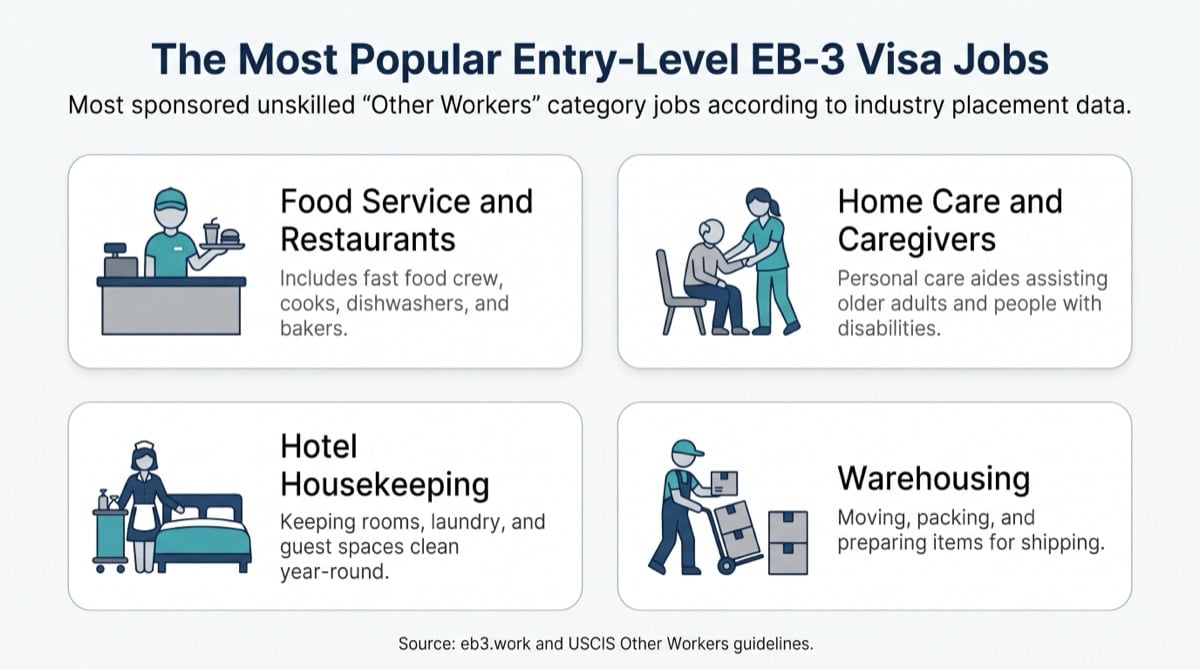
Fast Food and Quick-Service Restaurants
Fast food crew member and fast food cook are the most common entry-level jobs on eb3.work’s jobs page.
Crew members take orders, handle payments, prepare food and keep the restaurant clean. Cooks work the grill, fryer and other kitchen equipment. No restaurant experience is required, and training happens on the job.
The national median for fast food and counter workers is $15.00 an hour, and for fast food cooks, $14.85 an hour.
For a full look at the daily work, information on our current listings and every step of the green card process, read our guide to fast food jobs through the EB-3 visa.
Full-Service Restaurants and Bakeries
Sit-down restaurants hire for jobs like:
- Prep cook: washing, cutting and portioning food before service.
- Restaurant cook: cooking dishes to order on a line.
- Dishwasher: cleaning dishes, pots and kitchen equipment.
- Busser or dining room attendant: clearing and setting tables, refilling water.
- Baker assistant: mixing, shaping and baking.
Kitchens are hot and fast, especially at lunch and dinner. Evening, weekend and holiday shifts are normal. Most of these jobs train you on the job.
The national median for cooks is $17.62 an hour.
Hotels and Housekeeping
Hotel housekeepers (also called room attendants) clean guest rooms, make beds, change towels and sheets, and restock supplies. Some hotels also hire laundry workers.
The work is physical. You push carts, bend, lift mattresses and are on your feet all day. Most hotels give each housekeeper a set number of rooms to clean per shift. Weekend work is normal, because weekends are busy for hotels.
The national median for maids and housekeeping cleaners is $17.07 an hour.
Good to know: only year-round hotels fit the EB-3 visa. A resort that closes for part of the year offers seasonal work, which uses a temporary visa instead.
Commercial Cleaning and Janitorial
Janitors and commercial cleaners clean offices, schools, stores and other buildings. Tasks include vacuuming, mopping, emptying trash, cleaning restrooms and sometimes operating floor machines.
Many cleaning jobs run at night or early in the morning, when buildings are empty. You often work alone or in a small team. BLS says no formal education is typically required, and training is short and on the job.
The national median for janitors and cleaners is $17.71 an hour. Employers that work with eb3.work have sponsored a cleaner technician role in Longmont, Colorado, in the past. Learn more in our guide to EB-3 cleaning and housekeeping jobs.
Meat, Poultry and Food Processing
Food processing plants hire meat, poultry and fish cutters and trimmers, plus packers and line workers. You cut, trim, weigh or pack products on a production line.
Be ready for the conditions. Processing rooms are kept cold. The line moves fast, the work is repetitive, and many jobs involve knives. Employers provide protective gear such as gloves, aprons and boots.
The national median for meat, poultry and fish cutters and trimmers is $18.41 an hour.
Good to know: these plants run all year, which is why food processing fits the EB-3 visa well.
Manufacturing and Assembly
Factories hire assemblers, production associates and machine helpers to build, check and pack products. The work can involve hand tools, small machines and standing at a workstation for most of the shift.
BLS says these jobs usually involve several months of on-the-job training. That’s still well under the 2-year limit for Other Workers. Most assemblers work full time, and many factories run evening, night or weekend shifts.
The national median for assemblers and fabricators is $21.85 an hour. Employers that work with eb3.work have sponsored a manufacturing associate role in Brooklyn Park, Minnesota, in the past.
Warehousing and Material Moving
Warehouses and distribution centers hire loaders, order fillers (also called order pickers) and packers. You move boxes, load trucks, pick items for orders and prepare packages for shipping. Many warehouses use handheld scanners.
Expect lifting, walking and standing all shift. BLS says training usually takes 1 month or less. Some employers require forklift training for certain roles. When they do, the listing will say so.
The national median for hand laborers and material movers is $18.38 an hour.
Construction Laborers and Helpers
Construction laborers and helpers clean up job sites, carry materials, dig, mix concrete and assist skilled workers such as carpenters, roofers and masons. Most of the learning happens on site.
Pay is strong for entry-level work. The national median for construction laborers and helpers is $22.44 an hour. But the work is hard and can be dangerous: BLS lists construction laborers among the occupations with the highest injury and illness rates. You work outdoors in all weather and wear safety gear every day.
Good to know: the job has to be year-round. In cold places, winter often slows or stops construction, so a job with a winter shutdown won’t fit the EB-3 visa. Employers that work with eb3.work have sponsored construction laborer, delivery helper and precast concrete installer roles in the past.
Truck Drivers
Heavy truck driving is the highest-paying job family on this page. The national median for heavy and tractor-trailer truck drivers is $28.19 an hour.
It’s also the one job here that requires a license: a commercial driver’s license (CDL). BLS says CDL programs at community colleges last 3 to 6 months. After hiring, new drivers usually spend several weeks riding with an experienced driver. That’s still well under 2 years, so a driving job can fit the Other Workers group, as long as the employer’s job requirements stay under 2 years of experience. If a job requires 2 or more years of driving experience, it falls under a different EB-3 visa group.
The listing will say whether you must already hold a CDL when you start. Be honest with yourself about the lifestyle, too. Long-haul drivers can be away from home for days or weeks, and nights, weekends and holidays are common. Federal hours-of-service rules limit how many hours a driver can drive each day and week.
Trucking companies also hire yard workers and loaders, which don’t require a CDL. Employers that work with eb3.work have sponsored truck driver jobs in Missouri, Delaware and Washington in the past.
Home Care Aides
Personal care aides help older adults and people with disabilities with daily life: bathing, dressing, cooking meals, light housekeeping and going to appointments. You may work in a client’s home or in an assisted living facility.
This is the fastest-growing job family on this page. BLS projects 18% growth in jobs from 2025 to 2035. The national median for home health and personal care aides is $17.21 an hour.
Good to know: rules depend on the state and the type of employer. Some states require home health aides to be certified. Jobs that require a nursing license are not entry-level jobs and are outside the Other Workers group.
Other Year-Round Jobs: Dairy and Farm Shops
Some farm work runs all year. Dairy farms, for example, milk and feed animals every day. Large farms may also hire farm shop helpers to maintain equipment. Employers that work with eb3.work have sponsored a farm shop role in Dalhart, Texas, in the past.
Most farm work, though, is seasonal (planting and harvest). Seasonal farm jobs use the temporary H-2A visa, not the EB-3 visa.
Each of these job types appears on our jobs page when an employer is hiring. See current EB-3 job openings.
Jobs That Usually Don’t Qualify for the EB-3 Visa
Not every entry-level job can lead to a green card. These usually don’t qualify for the Other Workers group:
- Seasonal or temporary jobs. Summer resorts, ski seasons, harvest work and holiday jobs usually use the temporary H-2A or H-2B visas. If you’re already on an H-2B, read how to go from H-2B to EB-3.
- Part-time jobs. The EB-3 visa requires a full-time job.
- Jobs that require a degree or a professional license. Registered nurse, teacher and electrician are examples. These jobs require years of study or training, so they’re outside the Other Workers group. (A CDL is a license too, but it takes months, not years, to earn.)
- Jobs that require 2 or more years of experience. These fall under the EB-3 visa’s Skilled Workers group, which has a separate line.
- Self-employment, gig work and app-based work. The EB-3 visa requires a real employer offering you a real job.
- Remote jobs with no U.S. worksite. The job has to be at a specific location in the U.S.
- Internships and training programs. These are not permanent jobs, even if a job site lists them as “EB-3.”
How Pay Works for Entry-Level EB-3 Jobs
Your pay is set before your case is filed. The employer has to offer at least the prevailing wage, which the Department of Labor (DOL) sets for that job in that area. The employer requests it from DOL using a form called the ETA-9141. Most Other Workers jobs are paid at Level I, the entry level. Learn more in our ETA-9141 glossary entry.
That’s why an EB-3 offer is often lower than the national medians in the table above. The national median includes workers with years of experience, while the prevailing wage for an EB-3 Other Workers job is set for an entry-level worker in that specific area. Each listing on our jobs page shows its starting pay, so you can see the exact wage before you apply.
The wage is written into your job offer and the employer’s PERM labor certification (the DOL approval that comes before the green card petition). An employer can pay more than the prevailing wage, but not less.
When you compare jobs, compare the cost of living in each city too. A higher wage in an expensive city may leave you with less money than a lower wage in a cheaper one.
How to Choose the Right Entry-Level Job for You
You’ll likely work this job for years, so the right choice matters more than the highest wage. Go through this checklist before you apply.
Physical fit
- Can you stand or walk for a full shift?
- Can you lift heavy boxes, work in heat (kitchens) or cold (processing plants), or work outdoors in all weather (construction)?
Schedule
- Are you OK with nights, early mornings, weekends and holidays?
- For driving jobs, are you OK with days or weeks away from home?
Location
- You choose the city when you apply, because each offer is for one worksite.
- Think about climate, cost of living, and what your family will need there (schools, community, housing).
Requirements on the listing
- Check whether the job requires any experience, even a few months, and whether you can prove it with letters from past employers.
- Check whether a CDL is required for driving jobs.
- Check whether basic English is required. English is not a legal requirement for the EB-3 visa, but some employers require it for safety or for talking with customers.
Long-term commitment
- The full process takes about 48+ months.
- The green card is based on a real plan to work this job. Pick work you can see yourself doing when you arrive.
How Do You Apply for an Entry-Level EB-3 Visa? (Step-by-Step)
Once an employer offers you a job, the employer files and you wait through each government step. Here’s the short version:
- Job offer. You apply and the employer offers you the job.
- Prevailing wage and PERM. The employer requests a prevailing wage from DOL, recruits U.S. workers, and files the PERM labor certification. The PERM filing date becomes your priority date (your place in line).
- I-140. The employer petitions U.S. Citizenship and Immigration Services (USCIS) for you with Form I-140.
- Wait for your priority date. The State Department publishes the line’s progress each month in the Visa Bulletin.
- Green card. If you’re in the U.S., you may file Form I-485. If you’re abroad, you file the DS-260 and attend an interview at a U.S. consulate.
The whole process currently takes about 48+ months. For each step in detail, read how the EB-3 process works. For up-to-date numbers, see our page on processing times for the EB-3 visa.
Frequently Asked Questions
What jobs qualify for the EB-3 visa as an entry-level worker?
Permanent, full-time, year-round jobs that require less than 2 years of training or experience. Common examples are fast food crew and cooks, restaurant kitchen workers, hotel housekeepers, janitors, meat and poultry processing workers, assemblers, warehouse workers, construction laborers, truck drivers and personal care aides.
Can I get the EB-3 visa with no work experience?
Yes, if the job requires no experience. Many entry-level jobs, such as fast food crew member or hotel housekeeper, train you on the job. If a job requires a few months of experience, you need to prove it, usually with letters from past employers.
Do I need a degree for the EB-3 visa?
No. A degree isn’t required for jobs in the Other Workers group. Having a degree doesn’t stop you from taking one of these jobs, either.
Is English required for the EB-3 visa?
English is not a legal requirement for the EB-3 visa. An employer may require basic English for the job, for safety or customer contact. If so, the job listing will say it.
Can I choose which state I work in?
Yes, by choosing which job to apply for. Each job offer is for one specific worksite, so you pick the location when you pick the job.
Are caregiver jobs available through the EB-3 visa?
Yes, for entry-level personal care aide roles. Some states require home health aides to be certified. Jobs that require a nursing license are not part of the Other Workers group.
Can I get the EB-3 visa as a truck driver?
Yes, if the job requires less than 2 years of experience. Truck driving jobs require a commercial driver’s license (CDL), and the listing will say whether you must hold one before you start.
Can farm workers get the EB-3 visa?
Only for year-round farm jobs, such as work on a dairy farm. Seasonal farm work, like planting and harvest, uses the temporary H-2A visa instead.
How do I get a job offer for the EB-3 visa?
You apply to an employer that sponsors EB-3 workers. Start with our current EB-3 job openings, and see our guide to the best EB-3 job sites for other places to look.
Can my family come with me?
Yes. Your spouse and unmarried children under 21 can get green cards as your dependents.
Find Your Entry-Level EB-3 Job
Now that you know which jobs fit the EB-3 visa, the next step is finding one that’s open. eb3.work lists each job with its location, starting pay and PERM filing date, and we don’t charge recruitment or placement fees.
See current EB-3 job openings, and read how the EB-3 process works before you apply.
Sources
- U.S. Bureau of Labor Statistics, Occupational Outlook Handbook
- Cornell Law School, Legal Information Institute: 8 CFR 204.5 (definition of “other worker”)
- eb3.work: 2026 EB-3 Visa Jobs