
If you’re comparing the EB-3 vs H-1B visas, here’s the short answer. The H-1B is a temporary work visa for jobs that require at least a bachelor’s degree in a specific field, and you have to be picked in a yearly lottery to get one. The EB-3 is a green card. Its Other Workers category is open to jobs that require less than 2 years of experience and no degree at all.
For most people reading eb3.work (restaurant, hotel, factory, cleaning and warehouse workers), the H-1B isn’t an option. That’s not bad news. The EB-3 visa leads straight to permanent residence, without a lottery and without a temporary visa first. The honest downside: the EB-3 visa currently takes 48+ months.
In this guide you’ll learn:
- How the EB-3 and H-1B visas compare on requirements, cost, time and family
- What changed for the H-1B visa in 2026, including the $100,000 payment and the new wage-based lottery
- A simple checklist to see which path fits you
The EB-3 vs H-1B Visas at a Glance
| EB-3 (Other Workers) | H-1B | |
|---|---|---|
| Type of visa | Immigrant visa (green card) | Temporary work visa |
| Who it’s for | Workers in jobs that require less than 2 years of experience | Workers in “specialty occupations” |
| Degree required? | No | Yes, at least a bachelor’s in a specific field (or equivalent) |
| Lottery? | No, you wait in line by priority date | Yes, every March |
| Yearly limit | 10,000 green cards for Other Workers | 65,000 + 20,000 for U.S. master’s degrees |
| How long you can stay | Permanently | Usually 3 years, up to 6 in most cases |
| Family | Spouse and children under 21 can get green cards too | Spouse and children can get H-4 status |
| Change employers? | After you’re a permanent resident, yes | Only if a new employer files a new petition |
| Typical jobs | Food processing, hotel housekeeping, quick service restaurants, cleaning, assembly | Software, engineering, accounting, finance |
| Time to start working in the U.S. | Around 48+ months end to end | About 6 months after lottery selection, if picked |
The rest of this guide explains each row in plain words.
What Is the H-1B Visa?
Jobs That Require a Degree
The H-1B visa is for specialty occupations. Under the federal rules, that means a job that requires highly specialized knowledge and at least a bachelor’s degree in a specific field (or its equivalent) just to get started.
Examples are software developers, civil engineers, accountants and financial analysts.
The key point is that the job itself has to require the degree. Restaurant crew, hotel housekeeping, cleaning, food processing and assembly jobs don’t require a degree, so they don’t qualify for H-1B. This is true even if the worker happens to have a degree.
The H-1B Visa Lottery
Congress allows 65,000 new H-1B visas each year, plus 20,000 more for people with a U.S. master’s degree or higher. Many more people apply than there are spots, so employers register their workers every March and USCIS picks registrations at random.
Many more employers register than there are spots, so most registrants aren’t picked.
If an employer’s registration is picked, it can file the full H-1B visa petition. The job can’t start before October 1, the start of the government’s fiscal year.
How Long It Lasts
An H-1B visa is usually granted for up to 3 years and can be extended, generally to a total of 6 years. Extensions past 6 years may be possible for people with a pending green card case.
The H-1B visa allows dual intent. That means you can hold an H-1B visa and apply for a green card at the same time, without breaking the rules of your visa. But the visa itself is temporary. When it ends, you need another status or you have to leave.
What Changed for the H-1B Visa in 2026
Two big changes made the H-1B visa even harder to reach for workers outside the United States.
The $100,000 Payment for Workers Abroad
In September 2025, a presidential proclamation restricted the entry of H-1B workers unless their employer’s petition came with a $100,000 payment. On September 18, 2026, a new proclamation extended this for another 12 months, until September 21, 2027.
Here’s what it means in plain words:
- It targets H-1B visa petitions for workers who are outside the U.S.
- The employer must make the payment and keep proof of it before filing.
- The government can make exceptions it considers in the national interest.
For an entry-level worker abroad, the practical result is simple. Very few employers will pay $100,000 on top of normal costs to bring in one worker. And entry-level jobs don’t qualify for an H-1B visa anyway.
A Lottery That Favors Higher Wages
Starting with the FY 2027 season, the H-1B visa lottery isn’t fully random anymore. A rule that took effect on February 27, 2026 gives each worker a number of entries based on the wage level of the job offer:
- Wage Level IV (highest): 4 entries
- Wage Level III: 3 entries
- Wage Level II: 2 entries
- Wage Level I (lowest): 1 entry
Lower-paid offers get the fewest chances. Even for degree jobs, starting positions are now less likely to be picked.
These rules have changed quickly, and this section reflects them as of November 2026.
What Is the EB-3 Visa?
Three Groups, One Permanent Residence Visa
The EB-3 visa is an employment-based green card with three groups:
- Skilled workers: jobs that require at least 2 years of training or experience
- Professionals: jobs that require a U.S. bachelor’s degree or a foreign equivalent
- Other Workers: jobs that require less than 2 years of training or experience
Other Workers is the group that matters for most eb3.work readers. No degree is required, and many jobs require little or no experience. Read more about EB-3 Other Workers.
How the Process Works
In the EB-3 visa, the employer is the petitioner and the worker is the beneficiary. You can’t apply on your own. A U.S. employer has to offer you a full-time, permanent job and sponsor you.
The main steps are:
- PERM labor certification: the employer requests a prevailing wage from the Department of Labor, tests the U.S. job market, and files the ETA-9089. See PERM processing time.
- Form I-140: the employer petitions USCIS to approve you for the job.
- Waiting for your priority date: your place in line is set by your priority date.
- Final step: the DS-260 and an interview at a U.S. embassy or consulate if you’re abroad, or Form I-485 if you’re already in the U.S. and eligible.
For the full picture, see how the EB-3 process works.
The 10,000 Cap
Only 10,000 green cards a year go to the EB-3 Other Workers category, for the whole world. Spouses and children count against that number too. That small limit is the main reason the Other Workers line is long.
Key Differences Between the EB-3 and H-1B Visas
Temporary Visa vs Green Card
An H-1B visa lets you work for the employer that sponsored you, for a limited time. If you lose the job, you have a short grace period to find a new sponsor, change status or leave.
An EB-3 visa ends with a green card. As a permanent resident you can live in the U.S. long term, change jobs, travel within the green card rules, and later apply for citizenship. You’re expected to take the sponsored job when you get your green card, since that’s the job the process was built on.
Education and Experience Required
- H-1B visa: the job requires at least a bachelor’s degree in a specific field, and you must have that degree or its equivalent.
- EB-3 visa Other Workers category: no degree is required. The job requires less than 2 years of training or experience.
This is the difference that decides things for most of our readers. If the job doesn’t require a degree, the H-1B visa is not available. Full stop.
Lottery vs Line
The H-1B visa is a matter of chance. Each year you either get picked or you don’t, and you can try again next year.
The EB-3 visa process is a line. Once your employer files the PERM, you get a priority date. You move forward as the monthly Visa Bulletin advances. It’s slow, but nobody is drawing names.
Cost and Who Pays
H-1B visa: the employer pays most of the cost. Under Department of Labor rules, the worker can’t pay any part of the H-1B additional filing fee, directly or through wage deductions. For workers abroad, the employer would also have to make the $100,000 payment under the current proclamation.
EB-3 visa: the employer must pay all PERM labor certification costs, including the attorney’s work on PERM. Workers can’t pay these by law (20 CFR 656.12). For a full list of costs, see the EB-3 cost breakdown. Other costs, like the I-140 fees and the visa fees, can be paid by either the employer or the worker.
In eb3.work’s program, the beneficiary pays everything except PERM. The attorney represents only the employer, who petitions for you. Our team coordinates between the employer’s attorney and the worker at the visa stage.
Family
- H-1B visa: your spouse and unmarried children under 21 can get H-4 status. Spouses can only work in limited cases.
- EB-3 visa: your spouse and unmarried children under 21 can get green cards with you as derivatives. Once they’re permanent residents, they can work and study like you.
Which Is Faster: EB-3 or H-1B?
If you qualify for an H-1B visa and get picked, this is faster to start working. Selection happens in March and work usually starts in October. But it’s only for degree jobs, it’s a gamble every year, and it doesn’t give you a green card. Many H-1B visa workers still end up in a green card line later.
The EB-3 visa Other Workers category is slower to start but ends with permanent residence. Total time is:
PERM + I-140 + waiting for your priority date + visa interview
End to end, that’s often 48+ months for Other Workers. For current numbers, see current EB-3 processing times.
Here are the EB-3 Other Workers dates from the November 2026 Visa Bulletin:
| Country | Final Action Date | Date for Filing |
|---|---|---|
| All countries not listed | June 1, 2022 | July 1, 2022 |
| Mexico | June 1, 2022 | July 1, 2022 |
| Philippines | January 1, 2022 | June 1, 2022 |
| India | January 22, 2014 | January 15, 2015 |
| China (mainland born) | October 1, 2019 | October 1, 2020 |
In plain words: for most countries, visas are now being issued to Other Workers whose priority date is before June 1, 2022. That means people who started roughly four years ago. These dates change every month, and they can also move backward.
eb3.work supports the Dignity Act (H.R. 4393), which would change some of the reasons this line is so long. Spouses and children would no longer count against the yearly green card limits, and the per-country limit would rise. The bill is not law yet, and its text could change. Learn about the Dignity Act.
Can You Go From an H-1B to an EB-3 Visa?
Yes. Many H-1B visa workers move to a green card through the EB-3 process. Their employer files a PERM and an I-140, usually as a skilled worker or professional. Because the H-1B visa allows dual intent, this doesn’t cause a problem with their visa.
This route is for people who already hold an H-1B visa. If that’s you, read EB-3 for H-1B visa holders.
If your job doesn’t require a degree, there’s no H-1B visa step. You go straight to the EB-3 visa.
What About the H-2B Visa?
There is a temporary visa for entry-level jobs that don’t require a degree: the H-2B. It covers seasonal or temporary non-farm work, like landscaping, resort jobs and seasonal food processing.
This visa is different from those above:
- Unlike the H-1B visa, it doesn’t require a degree.
- Unlike the EB-3 visa, it’s temporary and doesn’t lead to a green card by itself.
Some H-2B visa workers later find an employer to sponsor them for an EB-3 visa. See H-2B to green card and our comparison of EB-3 vs H-1B vs H-2B.
Two Examples: How the Choice Plays Out
Real cases are easier to follow than rules. Here are two simple examples.
Example 1: Maria, a Hotel Housekeeper in Mexico
Maria has finished high school and has worked in hotel housekeeping for one year. A U.S. hotel offers her a full-time, permanent housekeeping job and agrees to sponsor her.
- H-1B visa? No. Housekeeping doesn’t require a bachelor’s degree, so it isn’t a specialty occupation. The hotel can’t register her in the lottery.
- EB-3 visa? Yes. The job requires less than 2 years of experience, so it fits Other Workers. The hotel files the PERM, then the I-140. Maria gets a priority date and waits for it to become current in the Visa Bulletin.
- What she should expect: several years from start to green card. She stays in Mexico during the wait, then attends her interview at the U.S. consulate.
Example 2: Ravi, a Software Engineer in India
Ravi has a bachelor’s degree in computer science. A U.S. tech company offers him a software engineering job.
- H-1B visa? Possibly. The job requires a specific degree, and he has it. But he is abroad, so under the current proclamation the employer would have to pay $100,000. He also has to be picked in the lottery.
- EB-3 visa? Also possible, as a professional. But India has the longest EB-3 visa line in the bulletin, so his wait could be much longer than Maria’s.
The point: the H-1B visa question only comes up when the job requires a degree. For jobs like Maria’s, an EB-3 visa is the path.
Which One Is Right for You? A Quick Checklist
Answer each question honestly:
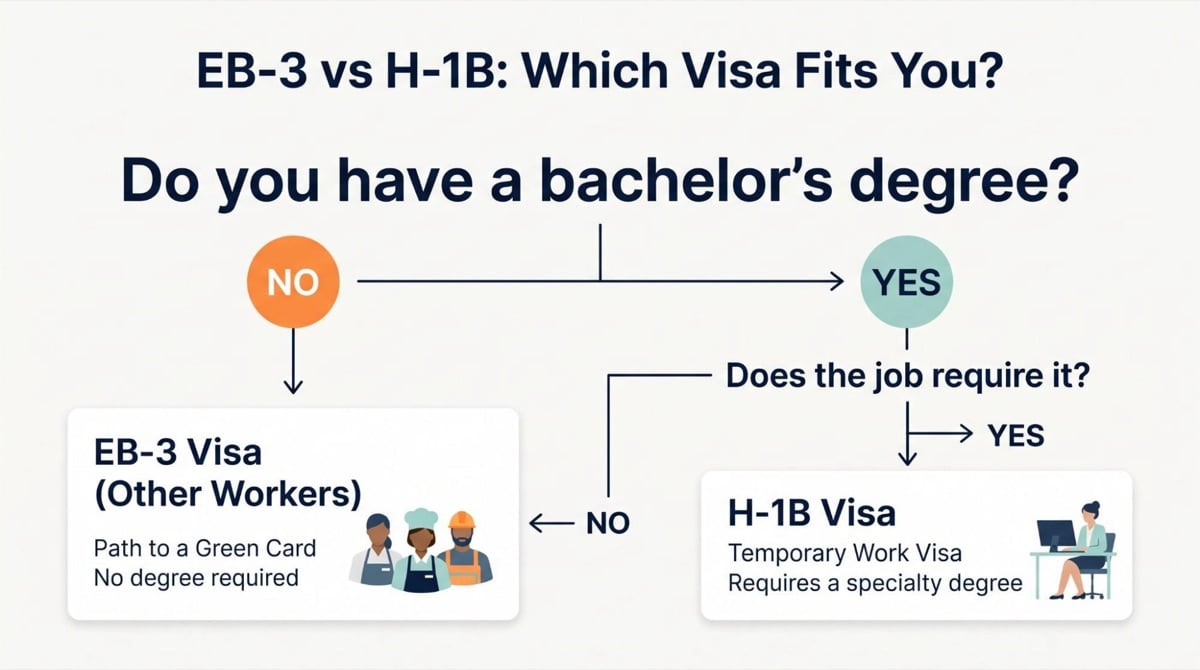
- Do you have a bachelor’s degree (or equivalent) in a specific field? If no, the H-1B visa is not an option. Look at the EB-3 visa Other Workers category.
- Does the job require that degree? If no, it’s not an H-1B visa job, even if you have the degree.
- Does the job require less than 2 years of experience? That’s the EB-3 visa Other Workers category.
- Are you outside the U.S. right now? Under current rules, an H-1B visa employer would have to pay $100,000 to bring you in.
- Do you want to live in the U.S. permanently? The EB-3 visa process ends with a green card. The H-1B visa doesn’t.
- Can you wait several years? The EB-3 visa is a long-term plan. Keep your job and life stable at home while your case moves.
If you answered “no” to the first two questions, your realistic employer-sponsored path is the EB-3 visa Other Workers category.
The employer and its attorney decide which category to file. If you’re offered sponsorship, request that they explain the category and why it fits the job.
Common Myths About the EB-3 and H-1B Visas
“The H-1B visa is a green card.” No. It’s temporary. A green card requires a separate process, often EB-2 or EB-3.
“The EB-3 visa is only for skilled workers.” No. The Other Workers group exists for jobs that require less than 2 years of experience.
“Anyone can enter the H-1B visa lottery.” Only for jobs that require a specific bachelor’s degree, and only if you have it.
“With an EB-3 visa, I can work in the U.S. while I wait.” Not if you’re abroad. Workers who process through a U.S. consulate usually wait in their home country until they get the visa.
“A green card through the EB-3 visa process is weaker than one through the H-1B one.” The H-1B visa doesn’t give a green card. And a green card is the same once approved, whatever category led to it.
Frequently Asked Questions
Which is better, the H-1B or EB-3 visa?
It depends on the job and your education. The H-1B visa is faster to start but temporary, requires a specific degree, and depends on a lottery. The EB-3 visa is slower but ends with a green card. For workers without a degree, the EB-3 visa Other Workers category is the only one of the two that’s available.
Who qualifies for an EB-3 visa?
A worker who has a full-time, permanent job offer from a U.S. employer that’s willing to sponsor them. They also have to meet the job’s requirements. For Other Workers, the job requires less than 2 years of training or experience. The employer must complete PERM and get an I-140 approved first.
Is an EB-3 visa hard to get?
The requirements aren’t hard for Other Workers. A degree isn’t required, and many jobs require little experience. The hard part is time. The 10,000-a-year limit means several years of waiting, and you need an employer willing to sponsor you through the whole process.
Does the EB-3 visa give you a green card?
Yes. The EB-3 visa is an immigrant visa, so it ends with a green card (permanent residence). Your spouse and unmarried children under 21 can get green cards too.
Can I apply for an H-1B visa without a degree?
Generally no. The job must require at least a bachelor’s degree in a specific field, and you must have it or its equivalent. Equivalent can include a mix of education and work experience, but this is evaluated case by case and doesn’t apply to entry-level jobs.
Do I need to win a lottery for an EB-3 visa?
No. There’s no lottery. You wait in line by your priority date, and you move forward as the monthly Visa Bulletin advances.
Can I have the H-1B and EB-3 visas at the same time?
Yes. Because the H-1B visa allows dual intent, an H-1B visa worker’s employer can sponsor them for an EB-3 green card while they keep working on the first.
Ready to Look at EB-3 Jobs?
If you don’t have a degree, EB-3 Other Workers is your path to a U.S. green card through work. Employers in restaurants, hotels, food processing and manufacturing sponsor these jobs now.
Browse EB-3 jobs with sponsoring employers and learn how the EB-3 process works before you apply.
Sources
- Federal Register: Weighted Selection Process for Registrants and Petitioners Seeking To File Cap-Subject H-1B Petitions
- The White House: Restriction on Entry of Certain Nonimmigrant Workers
- eb3.work: Support the Dignity Act (bill summary)
- U.S. Department of State, Visa Bulletin for November 2026 (travel.state.gov)
- USCIS: H-1B Electronic Registration Process
- eCFR: 20 CFR 655.731
- eCFR: 20 CFR 656.12