
Updated: November 12, 2026 | DOL data as of October 31, 2026
If your employer is sponsoring you for an EB-3 green card, the first government step is the EB-3 visa prevailing wage. This guide explains the current PWD processing time and what DOL’s numbers mean for your own wait. We update this page every month with the latest numbers from the Department of Labor (DOL).
Summary
- Right now: As of October 31, 2026, DOL was issuing PERM prevailing wage determinations for requests filed in August 2026. That’s when the request uses standard government wage data (OEWS).
- What that means: For most EB-3 visa Other Workers category cases, the prevailing wage step takes about 2 to 3 months.
- Other wage sources: Requests that use another wage source (non-OEWS) were at July 2026, about 3 to 4 months.
- No shortcut: There is no premium processing for the PWD.
- It’s only the first step. The PWD is the shortest DOL step. The ETA-9089 review and the visa bulletin wait take longer.
Current EB-3 Visa Prevailing Wage Processing Times (as of October 31, 2026)
DOL publishes PWD processing times on its FLAG processing times page. Here are the numbers that apply to the EB-3 visa cases:
| PERM prevailing wage queue | DOL is working on requests filed in | Rough wait |
|---|---|---|
| Standard requests (OEWS wage data) | August 2026 | About 2 to 3 months |
| Requests using other wage sources (non-OEWS) | July 2026 | About 3 to 4 months |
| Redeterminations | August 2026 | About 2 to 3 months |
| Center Director reviews | September 2026 | About 1 to 2 months after the review request |
The “rough wait” column is our estimate based on DOL’s processing month. It is not a DOL promise. For the full EB-3 visa timeline, from PWD to green card, see our current EB-3 processing times.
How to Read DOL’s “Processing Month”
DOL doesn’t publish a number of days for the PWD. It publishes the month of requests it is deciding now.
So “August 2026” means DOL is issuing decisions on requests that employers filed in August 2026. Requests filed in September, October and later are still waiting.
To estimate your own wait, compare two dates:
- The month the request was filed (you can see this in your eb3.work portal)
- The month DOL is working on now (from the table above)
The gap between them is roughly how many months of requests are still ahead of yours. If DOL is on August and your employer filed in October, about two months of requests are in front of you. If the queue keeps moving at its usual pace, your decision would come in about two months.
That’s an estimate, not a date. DOL can speed up or slow down from month to month.
Make Sure You Read the PERM Row
The FLAG page lists several prevailing wage queues, not just PERM. As of October 31, 2026:
- PERM: August 2026 (OEWS), July 2026 (non-OEWS)
- H-1B: July 2026
- H-2B: September 2026
- CW-1: September 2026
Only the PERM row applies to the EB-3 visa. The EB-3 green card goes through PERM labor certification, so your employer’s request sits in the PERM queue.
The H-2B visa queue often moves at a different speed because this is a seasonal, temporary visa with its own deadlines. If you’re coming from H-2B visa work, don’t use that row to estimate your EB-3 visa wait. Our guide on moving from H-2B to a green card explains how the two programs differ.
Is the Prevailing Wage Wait Getting Shorter?
For now, it looks that way:
- September 30, 2026: DOL was deciding PERM requests filed in June 2026, a wait of about 3 to 4 months.
- October 31, 2026: DOL was deciding PERM requests filed in August 2026, a wait of about 2 to 3 months.
In one month, the queue moved forward about two months. That’s good news if your employer filed recently.
But one month is not a trend. The PWD wait has gone up and down before, and it can change quickly. Government funding is one example. During the federal funding lapse in October 2025, DOL’s Office of Foreign Labor Certification stopped processing. DOL later announced it had resumed processing prevailing wage requests and labor certifications. Any request filed before or during a pause like that simply waits longer.
We check the FLAG numbers every month and update this page. If you’re waiting on a PWD, check back here before you make plans around a date.
What Is the EB-3 Visa Prevailing Wage?
A prevailing wage determination is DOL’s official decision about the minimum wage an employer must offer for a specific job in a specific area. The employer must get this decision before it can sponsor a foreign worker through PERM.
Here’s how it works:
- Your employer (the petitioner) files the request. It uses ETA Form 9141 and submits it online through DOL’s FLAG system. The rule says “the employer must request a PWD from the NPC,” DOL’s National Prevailing Wage Center (20 CFR 656.40).
- You (the beneficiary) don’t file anything at this step. Your name doesn’t need to be on the request.
- In eb3.work’s program, the attorney represents only the employer. The attorney prepares and files the request for the employer, not for the worker.
OEWS vs. Non-OEWS
DOL’s processing table splits requests into two groups:
- OEWS: DOL sets the wage using its standard government wage data, the Occupational Employment and Wage Statistics survey. This is the most common route, and it’s usually faster.
- Non-OEWS: The employer gives DOL another wage source, such as a private wage survey. If a union contract (collective bargaining agreement) covers the job, the wage in that contract is the prevailing wage (20 CFR 656.40(b)). These requests take longer to review.
Most EB-3 visa Other Workers category jobs, like restaurant, cleaning or factory work, use OEWS data. Many are set at the entry wage level (Level I).
Why the Prevailing Wage Matters to You
The PWD can feel like paperwork between your employer and the government. It matters to you for two reasons:
- It starts the clock. Nothing else in PERM can move until the PWD is issued, so every later date in your case depends on it.
- It sets the minimum pay. The green card job must pay at least the prevailing wage. DOL will not approve a PERM case where the offered wage is lower.
Where the Prevailing Wage Fits in the EB-3 Visa Timeline
The PWD is step one of PERM labor certification, and PERM is the first stage of the EB-3 process. Here is where it sits:
| Step | Who handles it | Rough time (Nov 2026) |
|---|---|---|
| 1. Prevailing wage determination (ETA-9141) | Employer, DOL | About 2 to 3 months |
| 2. Recruitment (job ads to test the U.S. labor market) | Employer | About 2 months |
| 3. ETA-9089 filing and DOL analyst review | Employer, DOL | About 300 to 360 days |
| 4. I-140 immigrant petition | Employer, USCIS | See current times |
| 5. Visa bulletin wait | You, waiting for your priority date | Often the longest step for Other Workers |
| 6. NVC and consular interview, or I-485 in the U.S. | You | See current times |
The ETA-9089 numbers come from DOL’s FLAG page. As of October 31, 2026, PERM analyst review decisions averaged 300 days over the last 30 days, 315 days over the last 90 days, and 360 days over the last 180 days. For the I-140, visa bulletin and final-stage numbers, see our current EB-3 visa processing times, which we keep up to date.
The PWD Is the Shortest DOL Step
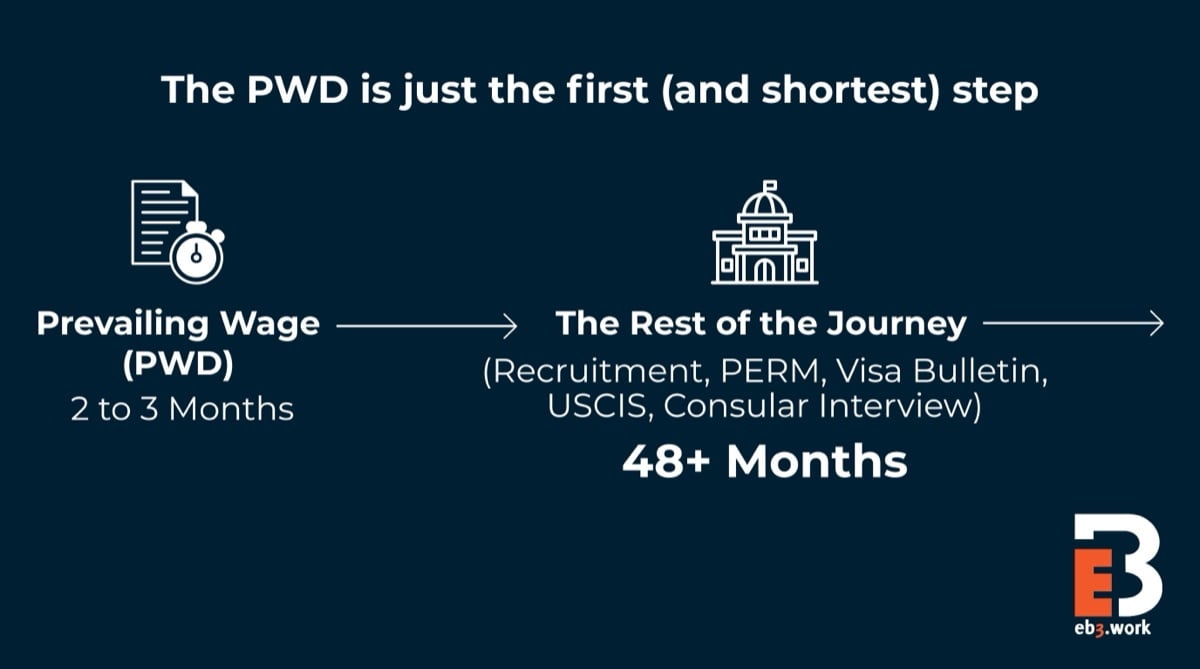
Compared with the rest of the process, the PWD is quick. The ETA-9089 review takes roughly four times as long. For the EB-3 visa Other Workers category, the visa bulletin wait is often longer than all of PERM together. Our guide to the full PERM timeline walks through each step in detail.
The PWD Date Is Not Your Priority Date
Your place in the green card line is set by your priority date. For PERM cases, the priority date is “the date the labor certification application was accepted for processing” by DOL (8 CFR 204.5(d)). That’s the date the ETA-9089 is filed, not the PWD date.
So a faster PWD helps only indirectly. It moves the ETA-9089 filing earlier, which gives you an earlier priority date by about the same amount. A month saved at the PWD stage is a month earlier in line, not more.
Worked Example: Estimating Your PWD Date
Let’s walk through an example using the October 31, 2026 numbers.
The case: A restaurant employer files ETA Form 9141 in mid-September 2026 for a line cook job. It uses standard OEWS wage data at Level I.
Step 1: Find the current processing month. As of October 31, 2026, DOL was deciding PERM OEWS requests filed in August 2026.
Step 2: Count the gap. The employer filed in September. DOL is on August. That’s about one month of requests still ahead of this one.
Step 3: Estimate the decision. If DOL keeps moving about one month at a time, September requests would be reached around late November to December 2026.
Step 4: Look at what comes next. After the PWD is issued:
- The employer runs recruitment, about 2 months: roughly January to February 2027.
- The employer files the ETA-9089, maybe around March 2027. That filing date becomes the worker’s priority date.
- DOL’s analyst review then takes about 10 to 12 months at current speeds.
Step 5: Keep it realistic. The PWD is a small part of a long process. The full EB-3 visa Other Workers category path, from PWD to green card, often takes around 48+ months in total.
Important: This is an estimate, not a promise. DOL only publishes the month it’s working on. The queue can speed up, slow down or stop, for example during a government funding lapse. Check this page monthly for updated numbers.
How Long Is an EB-3 Visa Prevailing Wage Determination Valid?
A PWD doesn’t last forever. DOL sets a validity period on each one. The rule says it “may [not] be less than 90 days or more than 1 year from the determination date”. The exact dates are printed on the determination.
Before the PWD expires, the employer must either:
- start recruitment, or
- file the ETA-9089.
If the employer misses that window, the PWD can’t be used. The employer has to file a new ETA-9141 and wait for a new decision. At current speeds, that adds another 2 to 3 months, or more if the queue slows down.
What Slows Down the Prevailing Wage Step
Most PWDs move with the normal queue. These are the most common reasons one takes longer.
- A non-OEWS wage source. Requests using a private survey or other source sit in a slower queue: July 2026 vs. August 2026 as of October 31.
- Job details that don’t match later forms. The 9141, the recruitment ads and the ETA-9089 must describe the same job. A mismatch can mean starting over.
- Requirements too high for the Other Workers category. The EB-3 visa Other Workers category jobs require less than 2 years of training or experience. If the request lists higher requirements, the case may not fit the category. See our guide to the EB-3 unskilled worker category.
- A request for review. If the employer disagrees with the wage, it can request a review within 30 days of the PWD (20 CFR 656.41). As of October 31, 2026, DOL was working on PERM Center Director reviews filed in September 2026.
- An appeal to BALCA. If the employer still disagrees, it can request review by the Board of Alien Labor Certification Appeals (BALCA) within 30 days of the Director’s decision. This adds more months.
- A redetermination. DOL was working on PERM redeterminations filed in August 2026.
- An expired PWD. If the validity period runs out before recruitment or the ETA-9089, the employer has to start the PWD over.
- Government funding gaps. When DOL’s foreign labor office stops processing, every request waits.
For most Other Workers jobs paid at the entry level, a review or appeal is uncommon. Mismatches and expired PWDs are the more realistic risks.
Can the EB-3 Visa Prevailing Wage Step Be Sped Up?
No. There is no premium processing for the prevailing wage step. Your employer can’t pay DOL to move a request up the queue, and neither can you. Our page on premium processing for PERM explains what is and isn’t available.
What does help keep the PWD on track:
- A complete, accurate 9141. Errors and mismatches cause the biggest delays.
- Using OEWS data when it fits the job. It’s the faster queue.
- Good planning after the PWD. The employer should start recruitment soon after the determination so the PWD doesn’t expire.
eb3.work supports the PERM Backlog Reduction Act (H.R. 10051), introduced in August 2026. It would create an optional, employer-paid premium track for the ETA-9089: a $1,200 fee for a decision within 30 days.
It would not speed up the prevailing wage step itself. But it requires that the new track not slow down standard PERM processing, and that its fees be enough to support timely ETA-9141 prevailing wage processing. The bill is not law yet, and its text could change. Learn more about the PERM Backlog Reduction Act.
Proposed Wage Rule: Could the Prevailing Wage Change?
In March 2026, DOL published a proposed rule that would raise prevailing wage levels for PERM and some temporary visas (Federal Register 2026-06017). Under the proposal:
- Level I would move from the 17th percentile of local wages to the 34th
- Level II from the 34th to the 52nd
- Level III from the 50th to the 70th
- Level IV from the 67th to the 88th
The comment period closed on May 26, 2026. As of November 12, 2026, it is still only a proposal. No final rule has been published, and the current wage levels still apply.
What this means for you:
- If a final rule is published, new PWDs would likely come with higher minimum wages, especially at Level I, where many Other Workers jobs sit.
- The proposal doesn’t say it would change processing time. We won’t guess at that.
- A higher required wage is good for the worker’s pay, but some employers may decide sponsorship costs too much at the new levels.
We’ll update this section if DOL publishes a final rule.
How to Check Where the Employer’s PWD Stands
Your employer, the petitioner, files the prevailing wage request through DOL’s FLAG system, and its attorney manages the case. The beneficiary is not allowed to be involved in any stage of the PERM recruitment process, and the prevailing wage request is where that process starts. This means you won’t file, sign or see the request yourself.
If you’re an eb3.work applicant, you can check your case status 24/7 in the eb3.work applicant portal. It’s the easiest way to follow your case without waiting for an update.
To see how fast DOL is moving overall, compare your status with the current processing month in the table above.
Who Pays for the EB-3 Visa Prevailing Wage (ETA-9141)?
DOL charges no filing fee for ETA Form 9141.
There can still be costs, like the attorney’s time to prepare the request. These are PERM labor certification costs. Under 20 CFR 656.12, the employer can’t seek or accept payment from the worker for labor certification costs.
In eb3.work’s program, the beneficiary pays for everything except PERM. The prevailing wage request is part of PERM, so the worker does not pay for it. For a full list of EB-3 costs and who pays each one, see our EB-3 visa cost breakdown.
Warning: If anyone requests money from you for the prevailing wage step, treat it as a red flag. By law, that cost belongs to the employer.
Frequently Asked Questions
How long does the EB-3 visa prevailing wage take right now?
As of October 31, 2026, DOL was issuing PERM prevailing wage determinations for requests filed in August 2026 (OEWS) and July 2026 (non-OEWS). That works out to about 2 to 3 months for most EB-3 cases, and about 3 to 4 months for requests using other wage sources. We update these numbers monthly.
How long does a prevailing wage determination take for PERM?
For PERM cases using standard OEWS wage data, a prevailing wage determination currently takes about 2 to 3 months from filing. DOL only publishes the month it’s working on, not a set number of days, so the wait can change from month to month.
What does “OEWS” mean on the DOL processing times page?
OEWS stands for Occupational Employment and Wage Statistics, the government’s standard wage data. An OEWS request means DOL sets the wage from that data. A non-OEWS request uses another source, like a private wage survey, and usually takes longer.
How long is a PWD valid?
A prevailing wage determination is valid for at least 90 days and up to 1 year from the determination date. The exact dates are on the determination. The employer must start recruitment or file the ETA-9089 before it expires, or it will need a new PWD.
Can my employer pay to speed up the PWD?
No. There is no premium processing for prevailing wage determinations. The best way to avoid delays is a complete, accurate request that matches the later recruitment ads and ETA-9089.
What happens after the PWD is issued?
The employer runs recruitment to test the U.S. job market, usually for about 2 months. Then it files the ETA-9089 with DOL. The ETA-9089 filing date becomes your priority date, your place in the EB-3 green card line.
How long does it take for an employer to sponsor a green card?
For the EB-3 visa Other Workers category, the full process currently takes 48+ months, from the prevailing wage step to the green card. The longest parts are usually the ETA-9089 review and the visa bulletin wait.
What is the prevailing wage for an EB-3 visa?
It’s the minimum wage DOL says an employer must offer for a specific job in a specific area before it can sponsor a worker through PERM. The employer requests it on ETA Form 9141. The green card job must pay at least that amount.
Ready to Start?
The EB-3 visa prevailing wage is the first official step toward an EB-3 green card, and right now it’s one of the shorter ones. The whole process still takes time, so it’s worth starting with the right job.
Browse current sponsored openings on our EB-3 jobs list, or see how our program works step by step in the EB-3 process.
Sources
- U.S. Department of Labor, FLAG: Processing Times
- eCFR: 20 CFR 656.41
- Federal Register: Improving Wage Protections for the Temporary and Permanent Employment of Certain Foreign Nationals in the United States (2026-06017)
- eb3.work: Support the PERM Backlog Reduction Act (H.R. 10051)