
Updated: November 2026
The EB-3 visa is a U.S. green card category for foreign workers who have a permanent, full-time job offer from a U.S. employer. The name stands for employment-based, third preference. Its Other Workers category covers jobs that require less than 2 years of training or experience, so a degree isn’t required.
This page explains what EB-3 means, its three worker categories and who qualifies. For the full process, current wait times and costs, see our full EB-3 visa guide.
What Does EB-3 Mean?
The Name, Letter by Letter
- EB means employment-based. You get the green card through a job, not through a family member.
- 3 means third preference. It’s the third of five employment-based categories in U.S. immigration law.
About 140,000 employment-based green cards are available each year, and that number includes workers’ spouses and children. They are split among five preference categories:
| Category | Who it’s for |
|---|---|
| EB-1 | People with extraordinary ability, top professors and researchers, and some multinational managers |
| EB-2 | Professionals with advanced degrees or exceptional ability |
| EB-3 | Skilled workers, professionals and Other Workers |
| EB-4 | Special immigrants, such as religious workers |
| EB-5 | Investors |
Only the EB-3 visa has a group for jobs that require less than 2 years of experience. That’s why it’s the category most entry-level workers mean when they search for “EB-3”.
Is the EB-3 Visa a Visa or a Green Card?
You’ll see both words. People say “EB-3 visa” and “EB-3 work visa” all the time. But EB-3 is not a temporary work visa. It’s an immigrant category, and the result is a green card: permanent residence in the U.S.
How you receive it depends on where you are:
- Abroad: you get an immigrant visa at a U.S. embassy, enter the U.S., and your green card arrives by mail.
- In the U.S. (in legal status): you apply to adjust your status, and USCIS issues the green card.
So yes, the EB-3 visa process gives you a green card. You can live and work in the U.S. permanently, and later apply for citizenship.
The 3 EB-3 Visa Worker Categories
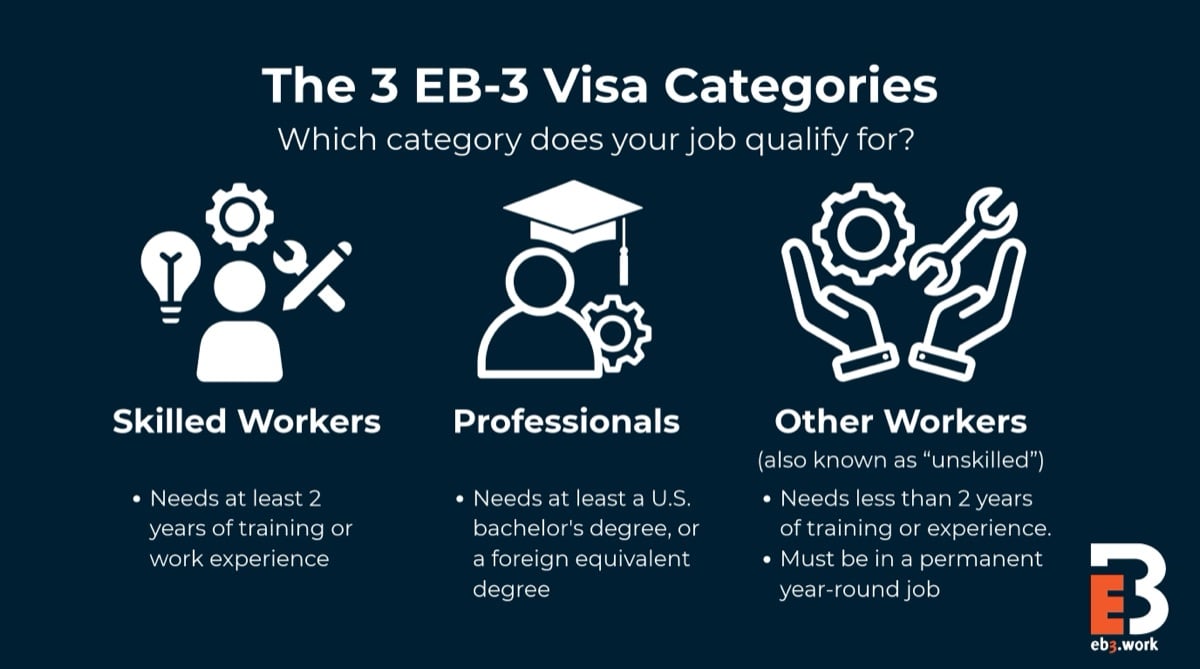
The EB-3 visa has three groups. Your group depends on what the job requires, not on your own background. If you have a college degree and take a hotel housekeeping job, your employer still files for you as an Other Worker.
| Category | What the job requires | Visa code (worker / spouse / child) |
|---|---|---|
| Skilled workers | At least 2 years of training or experience | E31 / E34 / E35 |
| Professionals | A U.S. bachelor’s degree or foreign equivalent | E32 / E34 / E35 |
| Other Workers | Less than 2 years of training or experience, in a job that is not temporary or seasonal | EW3 / EW4 / EW5 |
Skilled workers and professionals usually have a shorter wait. But those jobs require years of experience or a degree, so most eb3.work readers fit the third group.
Other Workers (the “Unskilled” Group)
USCIS describes Other Workers, also called unskilled workers, as people who can do unskilled labor in a job that requires less than 2 years of training or experience and is not temporary or seasonal.
“Unskilled” is a legal label about training time. It’s not a judgment of the worker. These are real, full-time, year-round jobs that employers struggle to fill, such as:
- Quick service restaurant crew and cooks
- Hotel housekeeping and laundry
- Commercial cleaning
- Assembly and manufacturing
- Food processing
- Caregiving aide roles
Seasonal work, like most farm or summer resort jobs, doesn’t qualify. For more on this group, see our unskilled worker entry. For the group that requires 2+ years of experience, see skilled worker.
What Is EW3?
EW3 is the official immigrant visa code for the EB-3 visa Other Workers category. It’s printed on the immigrant visa, which is why many people search for “EW3 visa.” A spouse gets EW4 and a child gets EW5.
EW3 is not a different program. It’s the same EB-3 visa Other Workers category under its official code.
Why Is the EB-3 Visa Other Workers Category Wait Time Longer?
EB-3 Other Workers is limited to 10,000 green cards a year, and spouses and children count against that number. Because of this limit, Other Workers usually wait longer than skilled workers and professionals. See our visa cap entry for how the limits work.
Who Qualifies for an EB-3 Visa?
To qualify for the EB-3 visa, these four things are required:
- A permanent, full-time job offer from a U.S. employer. Seasonal and part-time jobs don’t qualify.
- An approved labor certification. Your employer (the petitioner) completes PERM with the Department of Labor (DOL), which shows no qualified U.S. workers are available for the job. Then the employer petitions USCIS with Form I-140.
- You meet the job’s requirements, exactly as written on the PERM. If the job requires 3 months of experience, you must have it and be able to prove it.
- You pass the medical exam and background checks, like every green card applicant.
What’s Not Required for Other Workers
- A degree.
- U.S. work experience. Experience from your home country can count if the job requires any.
- A certain age. The law sets no age limit.
English isn’t a legal requirement for the category. But an employer may require it for the job. For example, USCIS notes an English standard on the labor certification for jobs driving commercial vehicles.
You Can’t Apply on Your Own
There is no self-petition in the EB-3 visa. An employer has to sponsor you. Without one, there is nothing to file.
Family
Your spouse and unmarried children under 21 can get green cards with you as your dependents.
For the full requirements and where you can apply from, see the full EB-3 visa guide.
How Does the EB-3 Visa Process Work?
Your employer gets a labor certification from DOL and then files an I-140 petition with USCIS. Next, you wait for your priority date to become current in the State Department’s monthly Visa Bulletin. Then you finish the process at a U.S. embassy abroad or by adjusting status inside the U.S.
Be ready for a long process. For many Other Workers cases, it currently takes 48+ months from start to finish. For current numbers at every stage, see our EB-3 visa processing times page. For how it works in our program, see the eb3.work process.
The EB-3 Visa Terms You’ll See
- Petitioner: the U.S. employer that sponsors you and files the paperwork.
- Beneficiary: you, the worker the petition is filed for.
- PERM labor certification: DOL’s approval that no qualified U.S. workers are available for the job.
- Prevailing wage: the minimum wage DOL sets for the job in that area. The employer must pay at least this.
- I-140: the petition your employer files with USCIS to show the job is real and you qualify.
- Priority date: your place in the green card line. For the EB-3 visa, it’s usually the date the PERM was filed.
- Visa Bulletin: the State Department’s monthly chart showing which priority dates can move forward.
- Other Workers / EW3: the EB-3 visa group for jobs that require less than 2 years of training or experience.
- Lawful permanent resident: the official name for a green card holder.
Frequently Asked Questions
What is EB-3?
The EB-3 visa is a U.S. green card category for foreign workers with a permanent, full-time job offer from a U.S. employer. It has three groups: skilled workers, professionals and Other Workers. The Other Workers group covers jobs that require less than 2 years of training or experience.
What does the term EB-3 stand for?
“EB-3” stands for employment-based, third preference. “Employment-based” means you get the green card through a job. “Third preference” means it’s the third of five employment-based categories in U.S. immigration law.
Does the EB-3 process give you a green card?
Yes. The EB-3 visa is a permanent immigration category, not a temporary work visa. When your case is approved, you become a lawful permanent resident, and your spouse and children under 21 can too.
What is the difference between the terms EB-3 and EW3?
There is no difference in the program. EW3 is the official immigrant visa code for the EB-3 visa Other Workers category. Spouses get the code EW4 and children get EW5.
Is a degree required for the EB-3 visa?
Not for Other Workers. A degree isn’t required for jobs that require less than 2 years of training or experience. Only the professionals group requires a bachelor’s degree.
Can I apply for an EB-3 visa without an employer?
No. The EB-3 visa requires a permanent, full-time job offer, and the employer must file for you. There is no self-petition option in the EB-3 visa process.
How long does the EB-3 visa take?
For many Other Workers cases, about 48+ months from start to finish. Most of that time is the wait for your priority date, which depends on your country of birth. See our EB-3 visa processing times page for current numbers.
Ready to Learn More or Find a Sponsor?
Every EB-3 visa case starts with an employer that agrees to sponsor you. To see what comes next, from the first step to your green card, read our full EB-3 visa guide. To see employers hiring now, browse our EB-3 jobs list.
Sources
- U.S. Citizenship and Immigration Services: Employment-Based Immigration: Third Preference EB-3
- U.S. Citizenship and Immigration Services: Green Card for Employment-Based Immigrants
- Electronic Code of Federal Regulations: 22 CFR 42.11, Classification symbols

Looking for
an EB-3 Visa Job?
Find your perfect job opportunity with an EB-3 visa. Apply for a job today and take the first step toward obtaining your Green Card and building your future in the United States.
Find EB-3 Visa JobsGlossary
I
I-131 (Application for Travel Document)
I-140 Petition (Immigrant Petition for Alien Worker)
I-485 (Application to Register Permanent Residence or Adjust Status)
I-765 (Application for Employment Authorization)
Immigrant Visa
Immigration and Nationality Act (INA)
Immigration Reform and Control Act (IRCA)