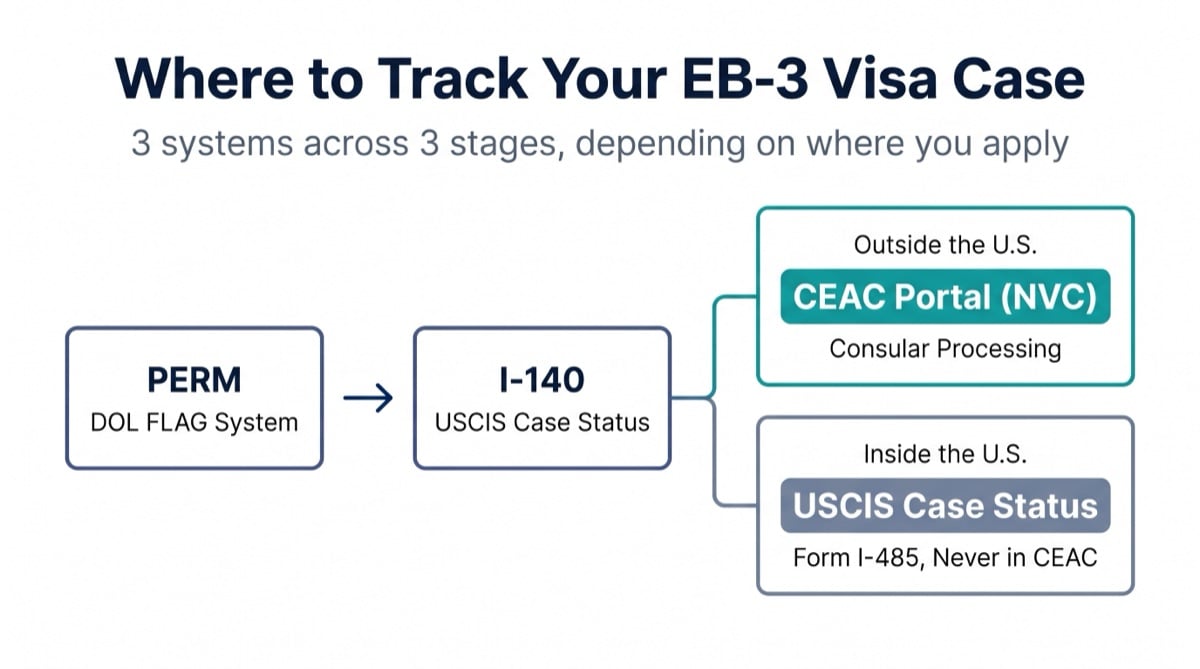
Your EB-3 visa case is tracked in three different places, depending on the stage: the Department of Labor’s FLAG system for PERM, USCIS Case Status Online for the I-140, and the State Department’s CEAC system once your case reaches the National Visa Center (NVC).
Most of this guide explains what each NVC case status and CEAC status means, because that is where workers abroad wait the longest.
Quick Answer: Where to Check Your EB-3 Visa Case Status
Each stage has its own agency, website and case number.
| Stage | Agency | Where to check | Number you need | Who usually has it |
|---|---|---|---|---|
| PERM labor certification | Department of Labor (DOL) | FLAG case status search | PERM case number | Employer / employer’s attorney |
| I-140 petition | USCIS | Case Status Online | Receipt number on Form I-797C | Employer / employer’s attorney |
| Immigrant visa | State Department (NVC, then the embassy or consulate) | CEAC | NVC case number (+ invoice ID to log in) | Applicant (also the petitioner and any attorney on the case) |
| I-485 (only if adjusting status in the U.S.) | USCIS | Case Status Online | I-485 receipt number | Applicant |
You only use one of the last two rows. Workers outside the U.S. go through the NVC. Workers adjusting status inside the U.S. stay with USCIS.
How to Track Your PERM Status
Your employer (the petitioner) files PERM, usually through its attorney, in DOL’s FLAG system. The decision goes to the employer or the attorney, not you.
Our PERM processing times guide and DOL FLAG glossary page explain the FLAG case status search. For current wait times, see EB-3 visa processing times.
How to Track Your I-140 Status
After PERM is certified, your employer files Form I-140 with USCIS and gets a receipt notice (Form I-797C) with a 13-character receipt number.
Common statuses are “Case Was Received,” “Request for Evidence Was Sent” and “Case Was Approved.”
Our guide on how to check EB-3 I-140 processing times walks you through it.
Does Your EB-3 Visa Case Go to the NVC?
Only if you will get your green card from outside the U.S. This is called consular processing. If you are already in the U.S. and file Form I-485 to adjust status, your case stays with USCIS and never appears in CEAC.
- Consular processing (most workers abroad): After USCIS approves the I-140, it sends the case to the NVC. The NVC creates your case and sends you a case number and invoice ID.
- Adjustment of status (workers in the U.S.): CEAC will show nothing for you. Track your I-485 on USCIS Case Status Online. See our adjustment of status guide.
For most EB-3 Other Workers applicants, the case then waits at the NVC until the priority date is current. To learn what the NVC is and what it does, see our NVC glossary page.
How to Check Your NVC Case Status
You can check your NVC case status in two ways. The public CEAC Visa Status Check needs only your NVC case number. The CEAC Immigrant Visa portal needs your case number and invoice ID, and it shows much more detail.
Your NVC Welcome Letter: Case Number and Invoice ID
After the NVC receives your approved petition from USCIS, it creates your case and sends an NVC case number and a separate invoice ID by letter or email. This is your Welcome Letter. You can’t pay fees or upload documents until the NVC tells you to begin.
Login details go to the applicant, the petitioner and the attorney, if one is designated. Share them only with people you trust, and only enter them on https://ceac.state.gov/.
The Two CEAC Tools
| Tool | What you need | What it shows | Use it when |
|---|---|---|---|
| CEAC Visa Status Check (ceac.state.gov/ceacstattracker/status.aspx) | NVC case number only | One status word, a date and a short note | You want a quick look, or you don’t have the invoice ID |
| CEAC Immigrant Visa portal (ceac.state.gov/iv) | Case number + invoice ID | Fees, DS-260, documents, NVC messages | You need to pay, upload, fix a document or read NVC messages |
To use the public status check: choose “Immigrant Visa (IV),” enter your case number, type the security code and submit. In the portal, the NVC posts a message every time your case status changes and emails every address on the case. Logging in also updates your contact date, so you don’t need inquiries just to keep your case active.
What Each Status in the CEAC Portal Means
After you log in, the status chart at the bottom of your summary page tells you what to do next.
The State Department’s rule is simple: if anything reads “Start Now,” “Incomplete” or “Not Submitted,” you must submit something to the NVC.
If everything says “Paid,” “Complete,” “In Process” or “Submitted,” the NVC is reviewing your case.
| CEAC column | Status | What it means | What you should do |
|---|---|---|---|
| Immigrant Visa Fee | Start Now | The immigrant visa fee has not been paid. | Pay the fee in CEAC. |
| In Process | Your payment is being processed online. | Wait. Don’t pay a second time. | |
| Paid | The NVC has received the fee. | Move on to the DS-260. | |
| DS-260 (IV Application) | N/A | The fee isn’t paid, so the form is locked. | Pay the immigrant visa fee first. |
| Start Now | You can begin the DS-260. | Start the form. See our DS-260 guide. | |
| Incomplete | You started the DS-260 but didn’t submit it. | Finish and submit it. | |
| Re-opened | The form was submitted but needs a change. Only the NVC or an embassy can reopen it. | Make the correction and submit again. | |
| Completed | The DS-260 was submitted to the NVC. | Print the confirmation page. | |
| Civil Documents | N/A | The DS-260 isn’t completed yet. | Submit the DS-260. |
| Start Now | No documents have been uploaded. | Gather and upload your documents. | |
| Incomplete | You started uploading but didn’t finish. | Upload the rest. | |
| Not Submitted | Everything is uploaded but not sent to the NVC. | Click submit. This is a common mistake. | |
| Submitted | Your documents were sent, and the NVC is reviewing them. | Wait, and check NVC timeframes. | |
| Invalid Doc | The NVC found something wrong or missing. | Read the NVC’s note on the documents screen and upload a corrected document. | |
| Accepted | The NVC reviewed your documents, and no changes are needed. | Nothing. |
Individual Document Statuses
Each document also has its own status.
| Status | What it means | What you should do |
|---|---|---|
| Missing | The document still needs to be uploaded and submitted. | Upload and submit it. |
| Uploaded | It’s scanned and uploaded but not submitted for review. | Submit it. |
| N/A | You marked the document as not available. | Be ready to explain why at the interview. |
| Submitted | It was sent to the NVC and is under review. | Wait. |
| Rejected | The NVC found an error. | Read the “Response Note,” delete the document, upload a corrected version and resubmit. The NVC also sends a CEAC message explaining the fix. |
| Accepted | The NVC reviewed it, and no changes are needed. | Nothing. |
The chart also lists each person’s role. Principal Applicant is you, the worker. Accompany is a spouse or child immigrating with you. Follow-to-Join is a family member who will immigrate later.
Check Your Consulate’s Interview Instructions
Every U.S. embassy and consulate publishes its own interview instructions, with a checklist of what to bring. Read them as soon as your case reaches the consulate. Two rules catch many applicants:
- Your originals must match what you uploaded to CEAC. If they don’t, the consulate can turn you away.
- Employment-based applicants usually need a recent employer letter. For example, the U.S. Consulate General in Ho Chi Minh City requires an employer letter dated less than one month before the interview.
You can find your consulate’s instructions on travel.state.gov or on the embassy’s website.
Why the Affidavit of Support Section May Not Apply to EB-3 Visa Workers
Most CEAC guides online are written for family cases, where the Affidavit of Support (Form I-864) is always required. For employment-based cases, Form I-864 is required only when a U.S. citizen or permanent resident relative filed the petition, or owns 5% or more of the employer that filed it. “Relative” here means a spouse, parent, child, adult son or daughter, brother or sister.
Most EB-3 Other Workers are sponsored by an unrelated employer, so no I-864 and no Affidavit of Support fee apply. If that section of your chart shows “N/A” or doesn’t appear at all, that is usually why.
What Does Your Public CEAC Status Check Mean?
The public CEAC Visa Status Check shows one word for where your immigrant visa case is: At NVC, In Transit, Ready, Administrative Processing, Issued or Refused.
| Status | What it means | What you should do |
|---|---|---|
| At NVC | Your case is at the National Visa Center. | Finish any open items in the CEAC portal. If everything is accepted, you’re waiting for a current priority date and an interview slot. |
| In Transit | The NVC is sending your case to the embassy or consulate. | Wait for your interview letter. |
| Ready | Your case is at the embassy or consulate (for example, Ho Chi Minh City). It may stay “Ready” before and after the interview. | Follow the consulate’s interview instructions. |
| Administrative Processing | Your case needs more review before a decision. | Wait. See the waiting periods below. |
| Issued | Your visa was approved and printed. | Wait for your passport, then pay the USCIS Immigrant Fee before you travel. |
| Refused | The officer could not issue the visa at this time. Often this is a temporary 221(g) refusal. | Read your refusal letter. See the next section. |
For EB-3 Other Workers, “At NVC” is usually the status you see longest, including the time many workers wait for a current priority date.
Does “Refused” Mean My Visa Is Denied? (221(g) Explained)
Not always. In CEAC, “Refused” often means a temporary refusal under section 221(g) of the Immigration and Nationality Act: the officer needs more documents or more review before deciding.
- You get a written notice. It lists any missing documents and how to provide them, or says your case needs administrative processing.
- It can be reversed. The State Department says an officer may reconsider a 221(g) refusal once you provide the information or the extra review ends. The status can then change to “Issued.”
- Two kinds: a document request (send exactly what the letter lists) and administrative processing (extra review; usually nothing to send unless requested).
- Other refusals are different. If your letter cites a section other than 221(g), it’s a finding that you aren’t eligible. Contact your employer’s attorney right away.
- Respond fast. A 221(g) refusal does not stay open forever.
Until your visa is issued, the State Department warns not to sell property, quit your job or buy non-refundable tickets.
What Does “Administrative Processing” Mean in CEAC?
Administrative processing means your case needs more review after the interview. How long it takes depends on the case. The State Department’s general guidance is to wait at least 180 days from the interview, or from sending requested documents, whichever is later, before asking about status (emergencies excepted).
Some consulates publish a shorter waiting period. For example, the Ho Chi Minh City consulate says 60 days. If your refusal letter or your consulate gives a different period, follow it.
“Documentarily Complete” but No Interview Yet: Why?
“Documentarily complete” means the NVC has everything it needs. You still need two more things before an interview: a current priority date and an open interview slot at your embassy or consulate.
- The NVC emails you when your case is documentarily complete. Write down the date.
- Your priority date must be current. EB-3 Other Workers is a limited category, so you can’t get an interview until your priority date is current in the Visa Bulletin. For Other Workers, this is usually the longest wait. See our guide to learn how to read the Visa Bulletin for your country.
- The consulate must have an open slot. The NVC says it cannot predict when an interview will be scheduled. Embassies tell the NVC which dates they’re holding, and the NVC fills them in order: first in, first out.
Don’t ignore NVC messages. Under INA section 203(g), if you don’t apply within one year after the NVC tells you a visa is available, your petition can be terminated. You could lose its benefits, including your priority date.
What to Do If Your NVC or CEAC Status Hasn’t Changed
First check the NVC’s posted timeframes. If your case is still within them, wait. If it’s past them, use the NVC’s Public Inquiry Form, or contact the consulate if your case has already moved there.
- Log in to CEAC and read every message. Look for “Start Now,” “Incomplete,” “Not Submitted” or “Invalid Doc.” Many stuck cases are waiting on the applicant.
- Past the timeframe? Submit the Public Inquiry Form once. Use your name exactly as in your passport. Replies come from an @state.gov address. Repeat inquiries slow responses.
- Case at the consulate? If your status is “Ready” or later, contact the consulate through its Immigrant Visa Inquiry Form, not the NVC.
- Administrative processing? Wait the period your consulate gives before you inquire.
- Involve the employer’s attorney if you get a refusal under any section other than 221(g), the job offer changes, or the NVC or consulate requests documents from the employer. In eb3.work’s program, request updates through our team. We coordinate with the employer’s attorney, who represents the employer, not the worker.
The NVC never charges for status checks. Only use .gov websites, and never pay anyone who offers to speed up your case.
Frequently Asked Questions
How long does NVC take after I-140 approval?
In mid-November 2026, the NVC took about 17 days to create new cases and about 10 weeks to review submitted documents. For EB-3 Other Workers, the longest wait is usually for a current priority date, which often adds two to three years. See our EB-3 visa processing times page for current numbers.
What is an NVC case number?
An NVC case number is the number the National Visa Center gives your immigrant visa case after it receives your approved I-140 from USCIS. It comes in your Welcome Letter with a separate invoice ID.
Can I check CEAC without an invoice ID?
Yes. The public CEAC Visa Status Check only needs your NVC case number. You need the invoice ID only to log in to the CEAC Immigrant Visa portal.
What does “At NVC” mean in CEAC?
“At NVC” means your case is with the National Visa Center and hasn’t been sent to an embassy or consulate yet. For EB-3 workers, this often lasts a long time while you wait for a current priority date.
Does “Refused” mean my visa is denied?
Not always. “Refused” often means a temporary 221(g) refusal: the officer needs more documents or more review. It can later change to “Issued.”
How long does administrative processing take?
It depends on the case. The State Department’s general guidance is to wait at least 180 days from the interview or from sending requested documents before inquiring. Some consulates give a shorter period in their own instructions.
Can I check my NVC status by phone?
The NVC’s status pages point to CEAC and the online Public Inquiry Form, not a phone number.
Ready to Start Your EB-3 Case?
You can only track a case once an employer sponsors you. If you’re still looking for a sponsor, browse our EB-3 jobs list and see how the eb3.work process works from job offer to green card.
Sources
- U.S. Department of State: CEAC FAQs
- U.S. Department of State: What is the status of my immigrant visa case?
- U.S. Department of State: NVC Timeframes
- U.S. Department of State: Step 12: After the Interview (221(g) and the 180-day administrative processing guidance)
- U.S. Department of State: U.S. Consulate General Ho Chi Minh City immigrant visa interview instructions
- U.S. Department of State: CEAC Visa Status Check and CEAC Immigrant Visa portal
- USCIS: Case Status Online
- U.S. Department of Labor: FLAG case status search